The right online reputation management company depends on the service you need. For negative name-search results, compare managed reputation agencies. For ongoing customer feedback, compare review software or managed review services. For unwanted content, request an assessment of the specific URLs and distinguish removal from suppression.
Editorial comparison updated October 13, 2026. This is a research-based shortlist organized by use case, without an invented numerical ranking or firsthand client-testing claim.
Online reputation management companies and software: quick comparison
The following providers offer different types of support. The fit descriptions are editorial buying guidance; confirm the current offering directly with each company. Read the linked profile for pricing questions, limitations and sources.
| Provider review | Provider type | Use case to evaluate |
|---|---|---|
| Status Labs | Managed reputation agency | Corporations and public figures evaluating search visibility and brand reputation support |
| Igniyte | Managed reputation agency | Companies, brands and individuals seeking an international reputation management proposal |
| Go Fish Digital | Digital agency with managed ORM services | Businesses and individuals comparing an SEO-led search reputation strategy |
| Birdeye | Business reputation and customer experience software | Brands with multiple locations evaluating centralized reviews and local visibility workflows |
| ReviewTrackers | Review monitoring and reputation software | Business teams seeking review analytics, location oversight and customer feedback workflows |
| Podium | Local business customer interaction platform | Local businesses comparing review requests alongside customer communication workflows |
| NetReputation | Managed reputation services | Businesses and individuals seeking a managed assessment of several reputation needs |
| ReputationDefender | Managed reputation services | Individuals comparing reputation visibility and online privacy support |
| Reputation X | Managed reputation services | Organizations and individuals assessing search reputation together with entity information |
| Five Blocks | Managed reputation services | Brands and executives evaluating reputation strategy across search and entity information |
| Reputation Rhino | Managed reputation services | People and businesses comparing a tailored reputation management engagement |
| WebiMax | Managed reputation services | Businesses and individuals comparing coordinated reputation and marketing services |
| Thrive Internet Marketing Agency | Digital agency and review services | Businesses comparing review operations with digital marketing support |
| Reputation.com | Business or healthcare reputation software | Multi-location organizations evaluating centralized reputation and customer experience software |
| rater8 | Business or healthcare reputation software | Medical practices comparing patient review generation and oversight |
| Patient Trak | Business or healthcare reputation software | Healthcare teams comparing patient feedback and reputation workflows alongside patient operations |
Managed ORM agency or review software?
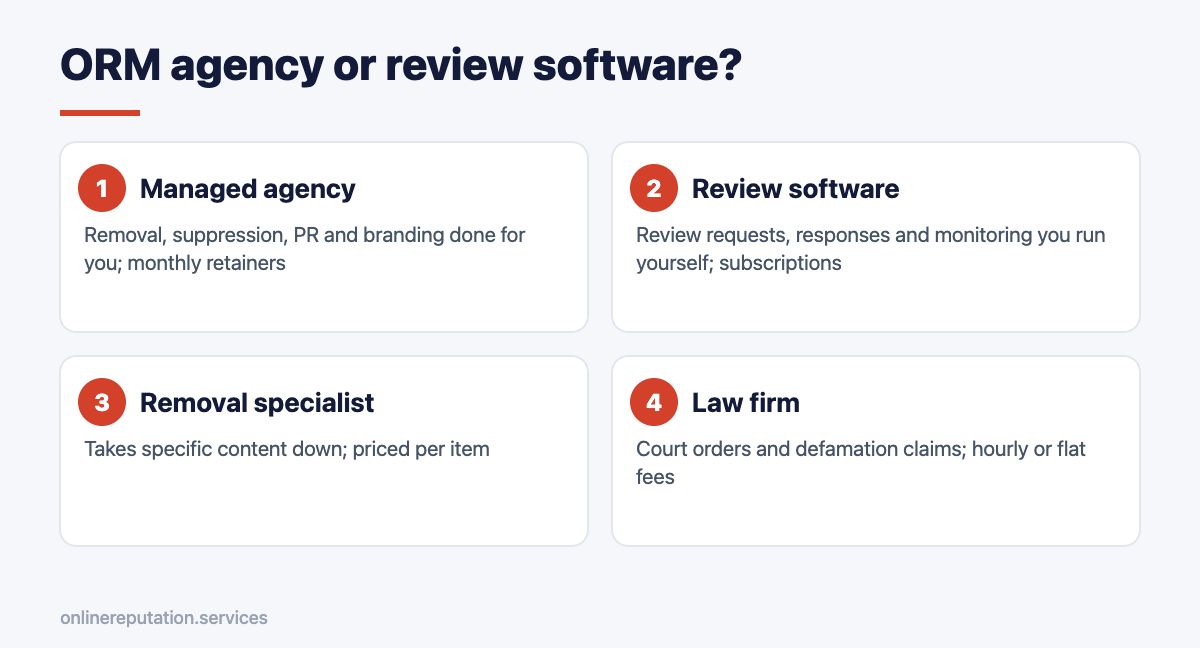
A managed agency performs an agreed set of services for you, such as research, content work, monitoring or reputation strategy. A review platform gives your team tools for gathering feedback, tracking reviews, responding and analyzing performance. A software subscription does not automatically include the staff to carry out all those tasks.
If your main issue is a negative article appearing for your name, ask for a search reputation plan. If your main issue is unanswered reviews across many locations, ask for a workflow demonstration. When both problems exist, compare separate scopes and reporting rather than expecting one generic package to solve everything.

How to shortlist an online reputation management provider
- Define the problem: Record affected URLs, name searches, review sites, locations and languages.
- Choose the provider type: Decide whether you need managed work, software, URL removal or a combination.
- Compare evidence: Request relevant references, a sample report and a clear explanation of the proposed method.
- Compare the full cost: Include setup, recurring charges, usage, locations, URLs and optional services over the proposed term.
- Confirm ownership: Define who owns accounts, created content and exports, and who approves public communication.
- Agree on reporting: Separate work completed, visibility changes and business outcomes.
Removal, delisting and suppression are different outcomes
Source removal takes content off the original website. Search delisting excludes an eligible result from a search engine but may leave the original page accessible. Suppression aims to reduce a result’s visibility by improving other relevant content. For a URL-specific assignment, ask the provider which route is being proposed and what qualifies as completion.
A provider cannot require every publisher or platform to remove material simply because a customer dislikes it. Get any guarantee, recurrence policy or pay-for-results promise in writing, with its conditions attached to your actual scope.
What does reputation management cost?
Costs vary with the work. Managed search programs, removal cases and multi-location software are different purchases. Request itemized quotes from at least two providers using the same brief. Confirm the minimum term, cancellation notice, renewal rules and the difference between software access and managed services.
Do not compare an entry-level software fee with a full agency campaign as if they include the same support. Use our reputation management cost guide as a checklist and verify current prices directly.
How to evaluate provider reviews and case studies
Look for recent feedback from buyers with a similar company size, industry and service scope. A complaint about a website project may not describe a removal engagement, and a selected success story does not establish a typical result. Ask what was delivered, how progress was measured and what the client retained when the work ended.
Directory inclusion and company-advertised capabilities are not guarantees of effectiveness. Read verification notes on legacy listings before contacting a provider.
Reputation management companies by specialty
The best company depends on the problem. These are some of the providers we review in each category:
| Need | Providers to compare | Typical model |
|---|---|---|
| Remove mugshots, court records or fake reviews | Defamation Defenders, Erase.com, Removify, Guaranteed Removals | Per item; some pay-after-removal |
| Suppress negative search results | Reputation X, ReputationDefender, NetReputation, Gadook | Monthly retainer |
| Executive and PR-led reputation | Status Labs, Five Blocks, Igniyte | Premium retainer |
| Review management software | Birdeye, Podium, ReviewTrackers, Reputation.com | Subscription per location |
| Healthcare reviews | rater8, PatientTrak | Per provider or location |
| AI reputation and visibility | OptimizeUp, Reputation X | Retainer or project |
| Privacy and data broker removal | RemoveOnlineInformation.com, BrandYourself | Subscription or per case |
| Legal removal and defamation | Minc Law | Flat fee or hourly |
Full rankings for each category are on our reputation management company rankings.
How reputation management companies work
Most managed providers follow the same basic process. They start with an audit of search results, reviews, profiles and AI answers; propose a plan that separates removals from suppression and review work; carry out quick wins such as removals, Google requests and profile fixes; run longer content and review programs; and report monthly. Software providers instead give you tools to run review requests, responses and monitoring yourself, with onboarding and support.
The difference matters for cost and control. Managed agencies cost more but do the work for you; software costs less but needs staff time; removal specialists and law firms handle specific items rather than ongoing programs.
Questions to ask before you hire
- Which of my problems will you remove, de-index, suppress or monitor, and how?
- What exactly am I paying for each month, and what triggers payment?
- What is the minimum term, and how do I cancel?
- Who owns the content, websites and profiles you create for me?
- How do you report progress, and how often?
- If removed content comes back or is reposted at a new URL, will you remove it again at no additional cost, and for how long?
- Can I speak to clients with a similar problem?
How to check reviews of reputation management companies
Reputation companies are, unsurprisingly, good at managing their own reviews, so read them critically. Look at the spread of ratings rather than the average, read the most recent one- and two-star reviews, and check whether the company replies. Compare Trustpilot, BBB, Google, Clutch and G2 rather than relying on one site, and watch for bursts of short five-star reviews posted close together. Our company reviews note rating counts, dates and any discrepancies we find.
Contracts and red flags
- Guaranteed first-page results or guaranteed removal of accurate news.
- Long contracts with automatic renewal and no performance terms.
- No distinction between removal and suppression in the proposal.
- Fake reviews, fake legal notices or other tactics that break platform rules or the law.
- Refusal to share references or examples of past work.
- Pressure to sign immediately.
A trustworthy provider explains what it cannot do as clearly as what it can, puts terms in writing and is willing to recommend free options when they will solve your problem.
What reputation management companies cost
Removal is usually priced per item, roughly $500 to $5,000 per project. Suppression and branding retainers commonly run $800 to $2,500 or more per month, with premium firms higher. Review software typically costs $89 to $400 or more per month per location or provider. See our reputation management cost guide for published prices and example budgets.
How to prepare before contacting an ORM company
- Search your name or brand from a private browser and list every negative or inaccurate result, with links.
- Note which reviews, articles, posts or listings worry you most and why.
- Check what ChatGPT, Gemini and Google’s AI Overviews say about you.
- Decide your goal: remove specific items, improve reviews, push results down, or build a stronger presence.
- Set a budget and timeline.
- Ask two or three providers for written proposals based on the same brief.
Clear preparation leads to more accurate quotes and makes it easier to spot providers who are selling the wrong service.
In-house vs. outsourced reputation management
Many businesses handle part of their reputation in-house: responding to reviews, requesting reviews through software, updating profiles and monitoring mentions. Outsourcing makes the most sense for specialist work such as removals, suppression, crisis communications and AI reputation, or when there is no one with time to run a consistent program. A common model is to keep day-to-day review management in-house with software and bring in a specialist when a specific problem appears.
Reputation management for individuals vs. businesses
Individuals usually need help with a small number of specific results: a mugshot, court record, article, people-search listing or damaging post. Removal and targeted suppression are the main tools. Businesses deal with a constant flow of reviews, listings and mentions across locations, so software, monitoring and processes matter more, with removal and PR as needed. Executives and public figures sit between the two and often need personal branding alongside company work.
What results to expect
Realistic outcomes depend on the problem. Removals either succeed or fail per item and usually take days to weeks. Review programs typically increase review volume within weeks and improve ratings over several months. Suppression often takes three to twelve months to move a result off the first page, and may not succeed against very strong news sites. AI answers change as sources change. A good provider will tell you which outcomes are likely, possible or unlikely before you sign.
The bottom line
Online reputation management companies range from removal specialists and law firms to large agencies and review software. Start by defining the problem, then shortlist two or three providers that specialize in it, compare written proposals that separate removal from suppression, and check their terms, reviews and references. The right company will be clear about what it can and cannot achieve, how long it will take and what it will cost.
Frequently asked questions
Which reputation management company is best?
There is no single best provider for every situation. Start with the type of problem, then compare matching providers on scope, evidence, price, ownership and reporting. The table above is organized for shortlisting, not a universal performance ranking.
Can an ORM company guarantee that all negative content disappears?
No company controls every publisher, platform or search engine. Ask for a URL-by-URL assessment and distinguish removal from reduced visibility.
How long does reputation repair take?
Timelines depend on the content, competition, platform process and service scope. Obtain a case-specific estimate and milestones. Do not treat a publication schedule as a guaranteed search ranking timetable.
Does review software replace a reputation agency?
It can support day-to-day review operations, but it does not automatically provide a search reputation strategy or URL removal. Decide which work your team can perform and what needs to be managed externally.
How should AI reputation claims be evaluated?
Ask which engines, prompts, languages and markets are monitored, how the baseline is captured and what source changes are proposed. AI answers can vary, so request repeated observations and a work log rather than a single favorable screenshot.
What is the best online reputation management company?
There is no single best company. Removal specialists such as Defamation Defenders are best for content that can come down; Reputation X and ReputationDefender for suppression; Status Labs for high-profile PR-led work; and Birdeye or rater8 for review programs.
Are reputation management companies legitimate?
Many are, but the industry has bad actors. Choose companies with written terms, clear methods, verifiable reviews and a physical address, and avoid anyone who promises guaranteed results for everything.
How do I choose between an ORM agency and review software?
Choose software if your main need is more and better reviews and you have staff to run it. Choose an agency if you need removals, suppression, PR or AI reputation work done for you.
How long do reputation management contracts last?
Software is often billed monthly or annually. Agencies commonly ask for three to twelve months. Removal specialists usually work per item without long contracts.
Can a reputation management company remove negative reviews?
Only reviews that break the platform’s rules, such as fake, spam or conflict-of-interest reviews. Genuine negative reviews cannot be removed ethically.
Do reputation management companies work with AI search?
Increasingly, yes. Providers such as OptimizeUp and Reputation X audit and improve what ChatGPT, Gemini and Google’s AI Overviews say about clients, though no one can guarantee AI answers.
How do I know if a reputation management company is working?
Agree on measurements before you start: positions of negative results, removals completed, review metrics and AI answers. Ask for monthly reports that show these.
Which reputation management companies offer guarantees?
Some removal specialists guarantee specific agreed removals, such as Defamation Defenders’ money-back guarantee on agreed removals. Suppression agencies rarely guarantee rankings. Read any guarantee carefully and get it in writing.
Explore related comparisons
- All reputation management company reviews
- Personal reputation management providers
- Business reputation management providers
- Content removal provider comparison
Sources and editorial method
This comparison draws on current provider information and the linked research-based directory profiles. Service availability and fees must be confirmed directly. Our use-case assessments and proposal questions are editorial analysis.
- Status Labs official information
- Igniyte official information
- Go Fish Digital official information
- Birdeye official information
- ReviewTrackers official information
- Podium official information
- NetReputation official information
- ReputationDefender official information
- Reputation X official information
- Five Blocks official information
- Reputation Rhino official information
- WebiMax official information
- Thrive Internet Marketing Agency official information
- Reputation.com official information
- rater8 official information
- Patient Trak official information