The best companies to help remove negative articles from Google in 2026 are Defamation Defenders, RemoveOnlineInformation.com, OnlineReputationRepair.com, Reputation X, NetReputation, Guaranteed Removals, NewReputation, Minc Law and Reputation Resolutions. News articles are among the hardest content to remove, because publishers rarely delete accurate reporting. A good company first asks the publisher to remove, update or anonymize the story, uses Google’s tools when the page changes, and falls back to suppression only when removal fails.
Last updated November 23, 2026. Researched and reviewed by Peter Anderson for Online Reputation Services.
Key takeaways
- Article removal happens at the publisher; Google only removes the result in limited cases or after the page changes.
- Old stories about dropped charges, minor matters or private people are the most likely to be updated or anonymized.
- Defamatory articles can be removed with a court order; accurate reporting usually cannot.
- When removal fails, suppression pushes the article down with stronger positive content.
- Ask whether a quote is for removal or suppression, and what happens if the article is republished.
How negative article removal works
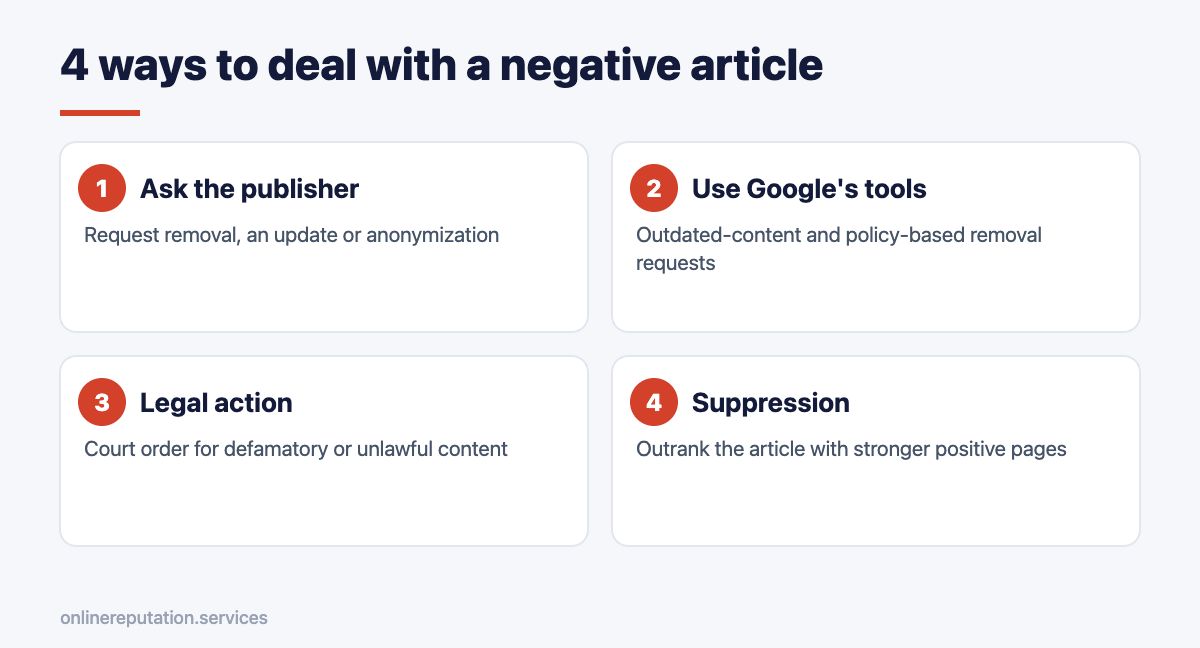
A news article stays in Google as long as the publisher keeps it online. So removal starts with the publisher: a request to remove the story, update it with the outcome of a case, or anonymize the person’s name. Many publishers now have “unpublishing” or update policies for old stories about minor matters, dropped charges or private individuals.
If the publisher removes or edits the page, Google’s outdated-content tool clears the old version from search. Google also removes some results under its own policies, such as personal contact information or content from sites that charge for removal. For defamatory articles, a court order can support removal from both the publisher and Google.
When none of that works, suppression builds and promotes accurate positive content so the article drops off the first page. It takes months and does not delete the article.
The top companies compared
| Company | Main approach | Best for |
|---|---|---|
| Defamation Defenders | Removal first, suppression as fallback | Removable articles and mixed problems |
| RemoveOnlineInformation.com | Public-record and personal-information removal | Articles tied to records |
| OnlineReputationRepair.com | Removal requests plus repair | Individuals and small businesses |
| Reputation X | Suppression and content | Articles that will not come down |
| NetReputation | Managed repair program | Broad repair needs |
| Guaranteed Removals | Managed publisher outreach | Readers seeking a quote for specific URLs |
| NewReputation | Managed content removal and reputation repair | Readers comparing help with articles and other online content |
| Minc Law | Legal review and publisher outreach | Readers seeking attorney-led help with harmful coverage |
| Reputation Resolutions | Article removal and de-indexing assessment | Readers seeking a review of specific article URLs |

1. Defamation Defenders
A removal-first company that reviews each article and recommends removal, de-indexing or suppression based on what is realistic for that publisher. It offers a money-back guarantee on agreed removals and pay-after-removal options on qualifying cases. Note that its free re-removal policy covers court-record and mugshot sites, not news articles, so ask what happens if an article is republished.
2. RemoveOnlineInformation.com
Best known for public-record and personal-information removal; useful when an article republishes arrest or court details that also appear on record and people-search sites.
3. OnlineReputationRepair.com
Combines removal requests to publishers with suppression and profile building for individuals and businesses.
4. Reputation X
A managed agency known for suppression, content development and AI visibility work for executives and companies. Best when an article will not come down and needs to be outranked.
5. NetReputation
A large managed agency offering removals, suppression and monitoring. Confirm which parts of a proposal are true removals and which are suppression.
6. Guaranteed Removals
Guaranteed Removals advertises publisher outreach and alternatives such as name redaction or de-indexing. Ask what counts as a billable result for each URL and whether syndicated copies are included. See provider information.
7. NewReputation
NewReputation lists news articles among the types of content it handles. Ask for a written plan that specifies which URLs it will submit for removal and whether search suppression is a separate service. See provider information.
8. Minc Law
Minc Law describes options including requesting removal, anonymization, or changes to search indexing. Ask what the firm would request from the publisher and how it bills for that work. See provider information.
9. Reputation Resolutions
Reputation Resolutions offers a dedicated negative article removal service. Ask which URLs it would submit for removal, when it would pursue de-indexing, and what counts as a billable result. See its article removal service.
Removal vs. suppression for news articles
Removal is faster, cheaper and permanent when it works, but publishers decide. Suppression always “works” in the sense that you can build content, but results take three to twelve months, cost a monthly fee and need maintenance. A strong provider will be honest about which applies to your article before taking your money.
Ask for a written assessment of each article: the publisher’s policy, the legal basis if any, the likelihood of removal and the fallback plan. Compare suppression providers on our best search result suppression companies page.
What article removal costs
Article removal is usually quoted per article after an assessment, and it is among the more expensive removal jobs, often in the thousands of dollars. Some firms offer pay-after-removal or money-back terms. Suppression for an article on page one commonly runs $800 to $2,500 or more per month for several months. See our reputation management cost guide for published prices.
Red flags
- A guarantee to remove any article from any publisher.
- No distinction between removal and suppression in the proposal.
- Fake legal notices or copyright claims; these can backfire and create new coverage.
- Large upfront retainers with no defined deliverables.
- No answer to: if the article is republished or reposted at a new URL, will you remove it again at no extra cost, and for how long?
How to ask a publisher to remove or update an article
A polite, well-documented request to the right person works more often than most people expect, especially for old stories about private individuals or dropped charges. Steps:
- Find the editor responsible for corrections or standards, not the general contact form.
- Explain briefly who you are and what has changed since publication, such as a dismissal, acquittal, expungement or correction of facts.
- Attach evidence: court documents, a corrected record or other proof.
- Ask for a specific outcome: removal, an update with the outcome, removing your name, or adding a noindex tag so the page drops from search.
- Be patient and follow up once or twice; do not threaten or argue.
Sample wording: “I am writing about your article of [date] about [subject]. Since publication, [the charges were dismissed / the record was expunged], as shown in the attached documents. The article continues to appear first when people search my name. I respectfully ask you to update the article with the outcome, remove my name, or remove the article from search results.”
Google’s tools for article results
- Outdated content removal: once a publisher removes or edits a page, ask Google to refresh or drop the old version.
- Personal information removal: Google removes results that expose contact details, ID numbers and some other personal data.
- Legal removal requests: for content found unlawful by a court, such as defamation, Google accepts removal requests with the court order.
- Results about you: monitors and helps remove results that show your phone number, address or email.
Google does not remove accurate news articles simply because they are negative or old, in the US.
Right to be forgotten in the EU and UK
People in the European Union and the United Kingdom can ask search engines to delist results about them that are inaccurate, inadequate, irrelevant or excessive, under the right to be forgotten established by the EU Court of Justice in 2014 and carried into data protection law. Search engines weigh the request against the public interest, and decisions vary. Delisting applies to searches for your name in those regions, not to the article itself.
Articles about arrests and criminal cases
Arrest stories are the most common type of article people want removed, and they are also among the most likely to be updated. Many newsrooms now review old arrest stories when charges were dropped or the person was acquitted, and some have formal policies to remove names or unpublish stories after a period of time. Lead with documents showing the outcome. If the story is accurate and recent, suppression is the more realistic path.
Articles about businesses
Business articles, such as reports of complaints, lawsuits or regulatory issues, are harder to remove because they are usually accurate and of public interest. The realistic options are to ask for corrections of factual errors, request an update with the outcome of a case, respond with your own statement on your website, and strengthen positive search results with reviews, press coverage and owned content.
How long negative articles stay in Google
There is no expiry date. An article stays indexed as long as the publisher keeps it online and Google considers it relevant to searches for your name. Older articles often drop naturally as newer content appears, but authoritative news sites can rank for years, especially for less common names. That is why combining a removal or update request with new, accurate content works better than waiting.
Suppression strategy for articles that will not come down
When an article stays up, a good suppression plan targets the exact searches where it appears and builds enough strong results to outrank it:
- A personal or company website with several useful pages, not a single thin page.
- Complete, active profiles on LinkedIn, industry directories and social platforms.
- Bylined articles, interviews and podcast appearances on reputable sites.
- Positive news coverage of real achievements, community work or company milestones.
- Video content, which often ranks well for names.
Each asset should be updated regularly and linked from the others. Expect three to twelve months for results, and keep publishing after the article drops so it does not climb back.
What not to do
- Do not file false copyright (DMCA) claims; they can be challenged, published and lead to legal liability.
- Do not threaten reporters or editors; that often becomes a new story.
- Do not flood the web with low-quality pages; Google ignores them and they can harm your brand.
- Do not pay anyone who promises to make any article disappear without explaining how.
Getting AI assistants to tell the full story
Even after an article drops in search, AI assistants may repeat it when someone asks about you. Correcting factual errors at the source, asking for updates that include the outcome of a case, and publishing a clear, accurate account on authoritative sites give those systems better material to draw on. Check what ChatGPT, Gemini, Perplexity and Google’s AI Overviews say about you before and during any campaign.
Negative article removal: FAQs
Can you remove a negative article from Google?
Sometimes. The most reliable route is to have the publisher remove, update or anonymize the article; Google then drops or updates the result. Google also removes results in limited cases, such as personal information or court-ordered removals.
Which company is best at removing negative articles?
Defamation Defenders is a strong first call for articles with a realistic removal route, Reputation X for articles that need to be outranked, and Reputation Resolutions for a second opinion on article removal or de-indexing.
How much does it cost to remove a news article?
Removal is usually quoted per article and often costs thousands of dollars. Suppression for an article that will not come down usually costs $800 to $2,500 or more per month for several months.
How long does article removal take?
A publisher can act within days, but outreach and appeals often take weeks. Legal routes take months, and suppression usually takes three to twelve months.
Can I ask a newspaper to remove an article myself?
Yes. Contact the editor, explain why the story is outdated or harmful, and attach proof such as a dismissal or expungement. Ask for removal, an update or anonymization.
Will Google remove a defamatory article?
Google may remove a result in response to a valid court order finding the content defamatory. It generally does not decide defamation claims itself.
Can I remove an article about my arrest?
Often you can get it updated or anonymized, especially if charges were dropped or the record was expunged. Contact the publisher’s editor with documents. If it remains, suppression can push it down.
Does the right to be forgotten apply in the US?
No. US law does not provide a general right to be forgotten, though some states have privacy laws covering specific data. EU and UK residents can ask search engines to delist certain results.
Will a noindex tag remove an article from Google?
Yes. If a publisher adds a noindex tag, Google drops the page from results after it recrawls it, while the article stays on the site. It is a useful compromise to ask for.
Does Google remove old news articles?
Not automatically in the US. Google keeps accurate articles in results as long as they stay online, unless the publisher removes or updates them or a specific policy or court order applies.
How do I find out who wrote a negative article?
News articles usually carry a byline and the publisher’s contact details. For anonymous blog or forum posts, a lawyer may need a subpoena to identify the author.
Can I pay a website to remove an article?
Some sites offer paid removal, but paying can encourage more of the same and may conflict with state laws or Google’s policies. Try a documented request first and use Google’s removal request for sites that charge for removal.
How much does it cost to suppress a negative article?
Suppression usually costs $800 to $2,500 or more per month, typically for three to twelve months, depending on the strength of the site and how competitive your name is.
Is it better to remove or suppress a negative article?
Removal or an update is better when it is possible, because it is permanent and often cheaper. Suppression is the fallback when the publisher refuses and the article is accurate.
Can a reputation company guarantee article removal?
No honest company can guarantee removal of any article, because publishers decide. Some offer guarantees for specific agreed removals with refunds if they fail; get those terms in writing.
Related guides and comparisons
- Top content removal services
- Best content removal companies (rankings)
- Best search result suppression companies
- How an ORM company can help you recover from negative press
- How much does reputation management cost?
Not sure which company fits? Tell us what you are dealing with and we will suggest two or three providers that fit the problem and your budget. Get a free shortlist.
Sources: provider websites and ORS company reviews, Google Search Help, and Reverbico’s roundup of article removal companies; checked November 2026. Company details and third-party ratings change; confirm current terms with any provider before you buy.
Not sure which company fits? Get a free shortlist.
Tell us what you’re dealing with. We’ll suggest 2–3 providers that fit the problem and your budget, with no obligation.