The best content removal services in 2026 are Defamation Defenders, OptimizeUp, RemoveOnlineInformation.com, ContentRemovalService.com, OnlineReputationRepair.com, NetReputation, Reputation Resolutions, Status Labs and Guaranteed Removals. They differ in what they remove, how they charge and whether they actually delete content or only push it down. Choose a provider that specializes in your type of content and puts its removal terms, timeline and re-removal policy in writing.
Last updated November 23, 2026. Researched and reviewed by Peter Anderson for Online Reputation Services.
Key takeaways
- Content removal deletes material at the source or removes it from search under a policy or law; it is different from suppression.
- Mugshots, court-record aggregator pages, fake reviews, doxxing and data broker listings are usually removable.
- Accurate news articles are the hardest to remove and may need suppression instead.
- Compare written terms: what counts as removed, when you pay, refunds and free re-removal if content returns.
- Google offers free removal routes for personal information and for pages on sites that charge for removal.
Why content removal services matter
A single negative article, mugshot, court-record page or fake review can sit on the first page of Google for years, costing job offers, customers and partnerships. It can also be repeated in AI answers from ChatGPT, Gemini and Google’s AI Overviews, which draw on the same pages.
Content removal services take that material down at the source or get it removed from search results. Unlike suppression, which only pushes results down, a successful removal is usually permanent and often cheaper. The catch is that not everything can be removed, and the industry is full of providers who blur the difference.
The top content removal services compared
| Provider | Best for | Model |
|---|---|---|
| Defamation Defenders (defamationdefenders.com) | Individuals and businesses who want specific content taken down | Removal-first |
| OptimizeUp | Clients who need search and AI answers cleaned up together | Removal plus repair |
| RemoveOnlineInformation.com (removeonlineinformation.com) | Privacy, public-record and data broker cleanup | Removal-first |
| ContentRemovalService.com | Single items with a clear removal route | Removal-first |
| OnlineReputationRepair.com | People who need removal and repair in one plan | Removal plus repair |
| NetReputation | Broader repair programs | Removal plus repair |
| Reputation Resolutions | Removal with ongoing repair support | Removal plus repair |
| Status Labs | High-profile people and brands | Removal plus repair |
| Guaranteed Removals | Dedicated source-removal assessment | Removal-first |
Below, each provider in more detail. Full reviews and rankings are on our best content removal companies page.

1. Defamation Defenders
Removal-first company in Boulder, Colorado, operating since 2016. It removes mugshots and arrest records, court-record pages, defamatory posts, policy-violating reviews and personal information, and uses suppression only when removal isn’t possible. It offers a money-back guarantee on agreed removals, pay-after-removal options on qualifying cases, free re-removal for court-record and mugshot sites, and a 7 to 14 business day standard for mugshots.
Best for: Individuals and businesses who want specific content taken down. Read our Defamation Defenders review.
2. OptimizeUp
Combines content removal and suppression with AI reputation management, answer engine optimization and AI visibility monitoring, for people and companies concerned about what Google and AI assistants say about them.
Best for: Clients who need search and AI answers cleaned up together. Read our OptimizeUp review.
3. RemoveOnlineInformation.com
Focuses on removing personal information, public records, booking photos and people-search listings, and publishes step-by-step opt-out guides for people who prefer to do it themselves.
Best for: Privacy, public-record and data broker cleanup. Read our RemoveOnlineInformation.com review.
4. ContentRemovalService.com
A removal service focused on taking unwanted content down at the source and from search results, quoted per case.
Best for: Single items with a clear removal route. Visit ContentRemovalService.com.
5. OnlineReputationRepair.com
Offers reputation repair for individuals and businesses, combining removal requests with suppression and profile building.
Best for: People who need removal and repair in one plan. Visit OnlineReputationRepair.com.
6. NetReputation
A large managed agency offering personal and business reputation repair, removals and monitoring. Much of its work is suppression, so confirm which items in a proposal are true removals.
Best for: Broader repair programs. Read our NetReputation review.
7. Reputation Resolutions
Lists removal, review management, monitoring, branding and crisis services, and runs free removal-request tools. Define what counts as a billable result in writing.
Best for: Removal with ongoing repair support. Read our Reputation Resolutions review.
8. Status Labs
A PR-led reputation firm for executives, public figures and companies, with content, media and Wikipedia expertise. Priced like a premium agency.
Best for: High-profile people and brands. Read our Status Labs review.
9. Guaranteed Removals
A removal specialist advertising content and mugshot removal. Check its written success, recurrence and payment conditions.
Best for: Dedicated source-removal assessment. Read our Guaranteed Removals review.
What can and can’t be removed
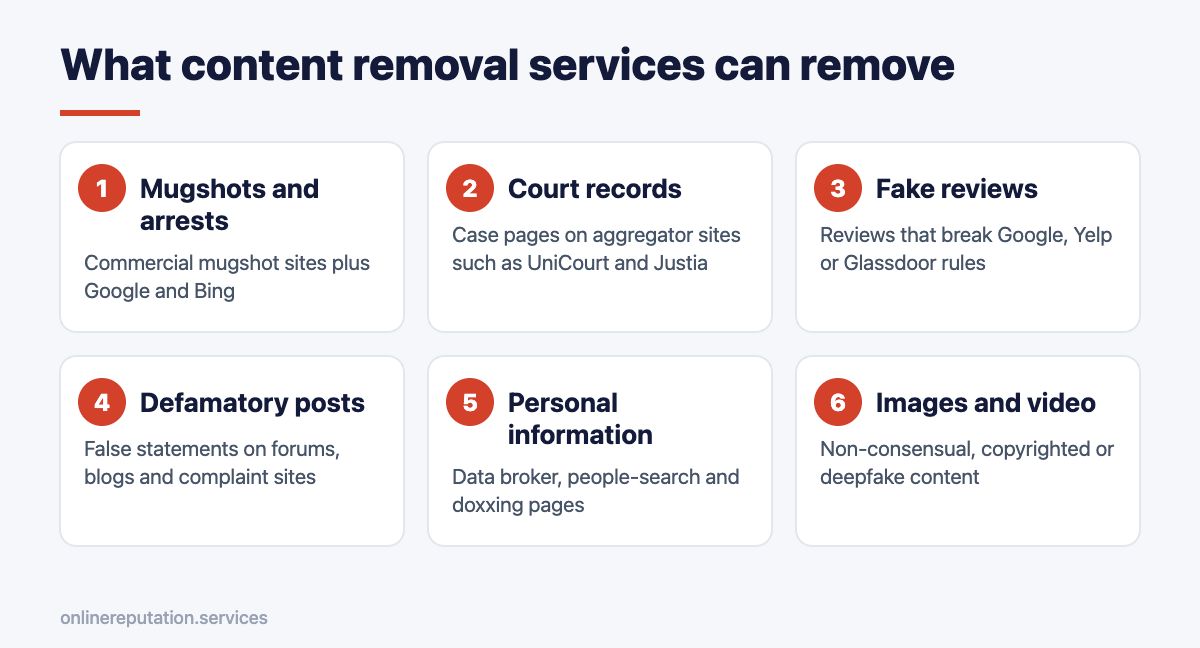
- Usually removable: mugshots on commercial sites, court-record aggregator pages, reviews that break platform rules, defamatory posts, personal information on people-search sites, copyright violations, doxxing and non-consensual images.
- Sometimes removable: old news articles (publishers may update or anonymize them), forum posts and complaint-site entries.
- Rarely removable: accurate, recent news coverage and official government records, unless a court seals or expunges them.
Google itself removes some content for free, including personal contact information through Results about you and pages on sites that charge for removal.
How to choose a content removal service
- Send each provider the same list of URLs and ask which can be removed, de-indexed or only suppressed.
- Get the price per item, what triggers payment and any deposit in writing.
- Ask for the timeline and how they report completed removals.
- Ask what happens if removed content comes back or is reposted at a new URL, whether re-removal is free, and for how long.
- Check recent reviews on Trustpilot, Google and BBB, and read our company reviews.
Avoid providers who guarantee removal of anything, who will not name the method, or who appear connected to the sites publishing the content. See what typical work costs in our reputation management cost guide.
Protecting your online reputation after removal
Once content is gone, keep it that way. Set up Google Alerts for your name or brand, check data broker sites every few months, and build accurate profiles and content that will rank first if something new appears. A monitoring service or a provider with free re-removal can handle repeat problems quickly. See our best reputation monitoring services.
How removal works for each type of content
Mugshots and arrest records
Commercial mugshot sites can usually be removed through their own processes, state mugshot laws or Google’s policy for sites that charge for removal. Government jail and court pages usually need expungement, sealing or agency policies. See our guide to whether mugshot removal services work.
Court records
Third-party aggregators such as UniCourt, Justia, Trellis and PacerMonitor republish dockets that rank for people’s names. Many remove or de-index case pages on request or in line with sealing orders. Official court systems cannot be changed by a private company.
Reviews
Fake, spam, conflict-of-interest, harassing and off-topic reviews can be flagged under Google, Yelp, Glassdoor and other platform policies. Genuine negative reviews cannot be removed ethically; respond professionally and build new reviews.
News articles
Publishers decide whether articles come down. Requests for updates, anonymization or noindex tags work best for old stories about private people. See our guide to the top companies to remove negative articles.
Personal information
Data broker and people-search sites offer opt-outs, and Google’s Results about you tool removes contact details from search. Brokers re-list people, so this needs repeating every few months.
Images, video and deepfakes
Non-consensual intimate images, copyrighted photos and AI-generated deepfakes can be removed under platform policies, copyright law (DMCA notices) and specific Google removal policies for explicit and synthetic imagery.
Forum posts and complaint sites
Forums and complaint sites vary. Some remove posts that break their rules or on proof of defamation; others refuse. Where removal fails, a court order or suppression may be needed.
Free removal tools to try first
- Google’s Results about you for phone numbers, addresses and emails.
- Google’s form for pages on sites that charge for removal.
- Google’s and Bing’s outdated-content tools after a page is removed or changed.
- Platform reporting tools on Google, Yelp, Facebook, Glassdoor and others.
- Data broker opt-out forms; RemoveOnlineInformation.com publishes step-by-step guides.
- DMCA takedown notices for content that copies your photos or writing.
Try these before paying anyone. If they fail, or there are too many items to handle yourself, a removal service is worth considering.
Legal options when removal requests fail
When a site refuses to remove clearly false and damaging content, an internet defamation lawyer can send a demand letter, identify anonymous posters through subpoenas and obtain court orders that support removal from the site and search engines. Section 230 of the Communications Decency Act generally protects platforms from liability for user posts, which is why court orders against the original poster are often the route. Legal action takes longer and costs more, so weigh it carefully. Minc Law is one firm that focuses on this work.
Removal vs. suppression: which do you need?
| If the content is… | Best approach |
|---|---|
| Breaking a platform’s rules | Removal through the platform |
| On a site that charges for removal | Google removal request plus direct removal |
| Defamatory and you can prove it | Legal demand or court order, then removal |
| Your personal contact information | Data broker opt-outs and Google tools |
| Accurate news coverage | Publisher update request, then suppression |
| An official government record | Expungement or sealing, then removal of copies |
How long content removal takes
| Content type | Typical timeline |
|---|---|
| Data broker and people-search listings | Days to a few weeks per site |
| Mugshots on commercial sites | About one to two weeks, plus search updates |
| Policy-violating reviews | A few days to several weeks, including appeals |
| Court-record aggregator pages | Days to several weeks |
| News articles | Weeks to months, if the publisher agrees |
| Content needing a court order | Several months or longer |
Search results usually update within days to a few weeks after the source changes. Ask providers for item-by-item timelines in writing.
How to prepare before contacting a removal service
- Make a list of every URL you want removed, with screenshots and the date you found each one.
- Note which searches show each result: your name, name and city, business name.
- Gather documents that support removal, such as dismissal or expungement orders, proof of identity, or evidence that a review is fake.
- Decide your goal for each item: removal, update, or simply pushing it down.
- Set a budget and ask for quotes from two or three providers using the same list.
Well-prepared clients get more accurate quotes, faster results and fewer surprises.
Keeping removed content from coming back
Content can return when a site re-publishes it, another site copies it, or a data broker re-lists you. Ask your provider what monitoring it includes, how quickly it acts on reposts, and whether re-removal is free and for how long. Defamation Defenders, for example, offers free re-removal for court-record and mugshot sites. Set up Google Alerts for your name or brand and check data broker sites every few months.
Content removal for businesses
Businesses most often need fake or policy-violating reviews removed, impersonation and counterfeit listings taken down, leaked documents or copyrighted material removed, and defamatory complaint-site posts addressed. Pair removal with a review program that keeps new, genuine reviews coming, so a single negative item has less impact. See our best online review management companies.
Content removal services: FAQs
What is a content removal service?
A content removal service gets unwanted online content, such as mugshots, fake reviews, defamatory posts or personal information, deleted at the source or removed from search results.
Which content removal service is best?
It depends on the content. For mugshots, court records and policy-violating reviews, a removal-first company such as Defamation Defenders is a strong fit; for personal information, RemoveOnlineInformation.com; for AI answers plus search, OptimizeUp; for high-profile PR issues, Status Labs.
How much do content removal services cost?
Removal is usually priced per item or project, roughly $500 to $5,000 depending on the content and site. Some companies offer pay-after-removal or money-back terms.
Can a company remove a news article from Google?
Sometimes. Publishers may update, anonymize or remove old stories, and Google removes pages in limited cases. Accurate, recent news usually needs suppression.
How long does content removal take?
Simple removals such as mugshots or data broker listings can take days to two weeks. Reviews and articles can take weeks, and legal routes take longer.
Is content removal permanent?
Removal at the source is usually permanent, but sites can repost content. Choose a provider that monitors and re-removes at no additional cost.
Can I remove content from Google myself?
Often, yes. Google’s tools handle personal contact information, outdated pages and pages on sites that charge for removal. You must usually get content removed at the source first for other types.
What is the difference between removal and de-indexing?
Removal deletes the content at the source. De-indexing removes it from search results while it stays online. Both stop most people from finding it through Google.
Can content removal services remove deepfakes?
Often, yes. Platforms and Google have policies against non-consensual and synthetic intimate imagery, and copyright or privacy laws can support removal of other deepfakes.
Do content removal services work for businesses?
Yes. Businesses use them for fake or policy-violating reviews, impersonation, counterfeit listings, leaked or copyrighted material and defamatory complaint-site posts.
What should I look for in a content removal service?
Clear written terms, an item-by-item plan that separates removal from suppression, realistic timelines, refund terms, free re-removal if content returns, and verifiable reviews.
Can content be removed from the Wayback Machine?
The Internet Archive accepts removal requests in some cases, such as from site owners or for personal information. A removal service can help prepare the request.
Is it legal to pay a company to remove online content?
Yes, when the company uses legitimate methods such as platform reports, removal requests, legal notices backed by real claims and search engine tools. Avoid anyone using fake legal claims or impersonation.
What content cannot be removed from the internet?
Accurate news reporting, official public records that have not been sealed, and genuine opinions or reviews that follow platform rules are generally not removable, though they can sometimes be updated, de-indexed or suppressed.
Related guides and comparisons
- Best content removal companies (rankings)
- Top companies to remove negative articles from Google
- Best companies to remove mugshots
- How much does reputation management cost?
- Types of online reputation management
Not sure which company fits? Tell us what you are dealing with and we will suggest two or three providers that fit the problem and your budget. Get a free shortlist.
Sources: provider websites and ORS company reviews, Google Search Help, checked November 2026. Company details and third-party ratings change; confirm current terms with any provider before you buy.
Not sure which company fits? Get a free shortlist.
Tell us what you’re dealing with. We’ll suggest 2–3 providers that fit the problem and your budget, with no obligation.