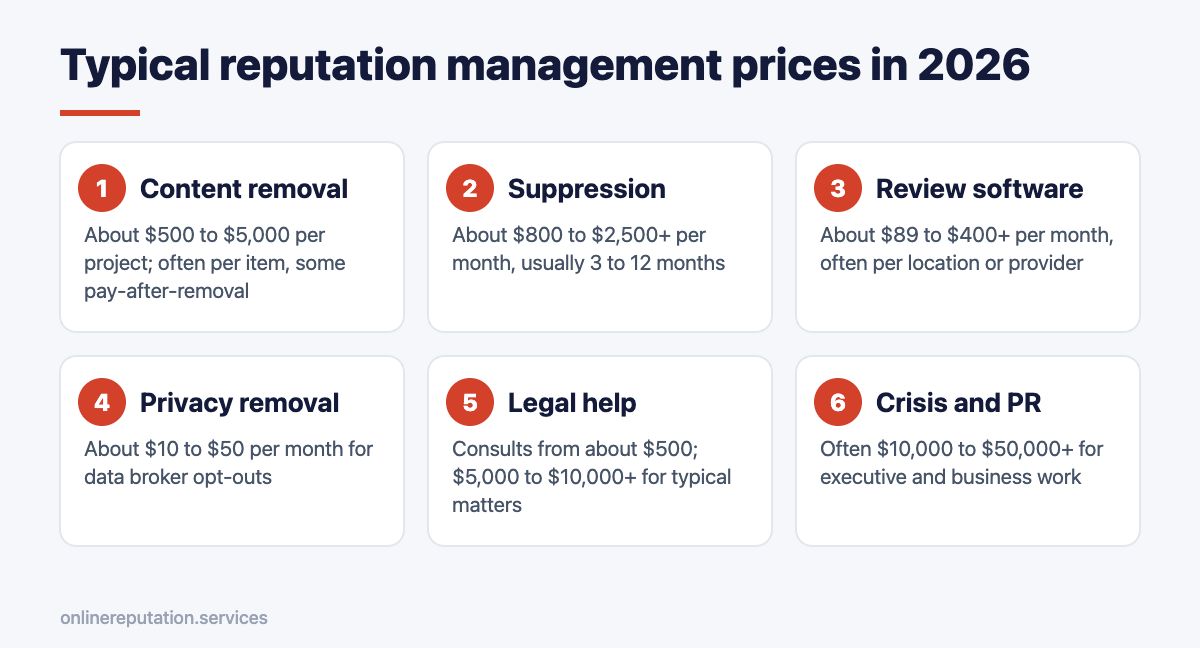
Online reputation management usually costs $500 to $5,000 for a one-time removal project, $800 to $2,500 or more per month for suppression and branding, and $50 to $400 per month for review or privacy software. Law-firm and crisis work costs more: about $5,000 to $10,000 for a typical non-lawsuit legal matter and $20,000 or more for litigation. What you pay depends far more on the type of work than on the company, so price the problem first and the provider second.
Last updated November 23, 2026. Researched and reviewed by Peter Anderson for Online Reputation Services.
Key takeaways
- Removal is usually priced per item or per project and is the cheapest fix when a removal route exists.
- Suppression and branding run on monthly retainers, and most campaigns need at least three to six months.
- Review and privacy tools are subscriptions; per-location or per-provider pricing adds up for multi-location businesses.
- Ask what triggers payment, whether there is a deposit and whether re-removal is free if content comes back.
- Very low prices with guaranteed results, or very high prices with no defined deliverables, are both warning signs.
What drives the cost of reputation management
Reputation management is not one service, so it does not have one price. The biggest factors are:
- Type of work. Removing a page is a defined task; pushing results down is an ongoing campaign.
- How many items or results. One fake review is a very different job from ten negative news results.
- Where the content is. A mugshot site, a major newspaper and a court-record aggregator each need a different approach.
- How competitive the name is. A common name or a well-known company needs more content and time to move results.
- Who does the work. Law firms and PR agencies bill more than specialist removal companies or software.
- Speed. Active crises cost more because the work is concentrated in days, not months.
The ranges below come from prices the companies publish and from third-party data in our company reviews. They are typical ranges, not quotes.
Content removal costs
Removal is usually priced per item or per project, and it is often the cheapest fix when a route exists, because the work ends once the page is gone.
- Erase.com quotes each case and says clients pay when results are delivered; third-party roundups put typical projects at roughly $500 to $5,000.
- Removify charges per review with a refundable deposit, and you pay the balance only for reviews that are removed.
- Reputation911 lists individual plans starting from $500.
- Defamation Defenders quotes per item after a free review, offers pay-after-removal on qualifying cases and payment plans, and gives a money-back guarantee on agreed removals.
- Minc Law, a law firm, charges flat fees for many website removals and refunds part of the fee for content it cannot remove.
Mugshot removal from a single commercial site is usually at the low end. News articles and court records cost more because they take outreach, legal arguments or de-indexing requests.
Search suppression and branding costs
Suppression and online branding run on monthly retainers because the work is ongoing: creating and promoting positive content until it outranks the negative result.
- BetterReputation charges a flat $1,000 per month with no long-term contract.
- Gadook publishes monthly plans starting at $800 for individuals, $1,000 for professionals and $1,250 for businesses.
- Premium firms such as ReputationDefender and Status Labs quote after a consultation; budgets often start in the low thousands per month and reach five figures for complex projects.
Plan for at least three to six months. A first engagement for an individual commonly totals $3,000 to $15,000; executive and business campaigns can run much higher. Ask whether you keep the content and accounts created for you if you cancel.

Review management software costs
Review software is billed monthly, usually per location, per user or per provider. Healthcare tool rater8, for example, publishes plans at $89 and $109 per physician per month, with a free monitoring tier. General platforms such as Birdeye and Podium quote by location and feature bundle and typically cost a few hundred dollars per location per month.
Watch for setup fees, annual or multi-year terms and per-location pricing that grows quickly for multi-location businesses.
Privacy and data broker removal costs
Data broker removal is the cheapest category. Consumer services typically cost about $10 to $50 per month or a little more per year, because they need to re-check brokers that re-list people. Defamation Defenders’ monitoring plan is $49 per month, and RemoveOnlineInformation.com handles people-search and personal-information removals.
You can also do it yourself for free with each site’s opt-out form and Google’s Results about you tool, but it takes hours and must be repeated.
Legal and crisis costs
When content needs a court order, a subpoena to unmask an anonymous poster, or a defamation claim, you need a lawyer. Minc Law publishes typical ranges of $5,000 to $10,000 for non-lawsuit matters and $20,000 to $60,000 or more for litigation, with consultations from $500.
Crisis PR is priced like PR. Clutch data for firms such as TheBestReputation and Reputation911 shows many business and executive projects in the $10,000 to $49,999 range.
Example budgets
| Situation | Typical approach | Estimated cost |
|---|---|---|
| One mugshot on a commercial site | Removal | A few hundred to about $1,500 |
| Three fake Google reviews | Removal, per review | Roughly $500 to $3,000 |
| Court case pages on several aggregator sites | Removal or de-indexing | Roughly $1,000 to $5,000 |
| Accurate news article on page one | Suppression, 6 months | Roughly $6,000 to $20,000+ |
| Address and phone on people-search sites | Privacy subscription | About $120 to $600 per year |
| 10-location business needing more reviews | Review software | Several hundred to a few thousand dollars per month |
| Executive with an active negative story | Crisis PR plus suppression | $10,000 to $50,000+ |
These are estimates based on the published prices and third-party data above. Get at least two written quotes using the same list of links and the same goals.
How to avoid overpaying
- Send the exact links. A firm quote needs the URLs, not a description.
- Ask which type of work each item is: removal, de-indexing or suppression. Removal is often cheaper and permanent.
- Ask what triggers payment and whether there is a deposit or setup fee.
- Ask about re-removal: if removed content comes back or is reposted at a new URL, will they remove it again at no extra cost, and for how long?
- Check the term: monthly, three-month minimum or annual, and how cancellation works.
- Try free tools first for personal information and pages on sites that charge for removal: Google may remove them from search for free.
Be wary of very low prices with guaranteed removal of anything, and of large retainers with no list of deliverables or reporting. Compare providers on our reputation management company rankings.
Reputation management pricing by provider type
| Provider type | Typical pricing model | Typical range | Examples |
|---|---|---|---|
| Removal specialist | Per item or per project; some pay-after-removal | About $500 to $5,000 per project | Defamation Defenders, Erase.com, Removify |
| Suppression and branding agency | Monthly retainer, often 3 to 12 months | About $800 to $2,500+ per month; premium firms higher | Gadook, BetterReputation, ReputationDefender |
| Review software | Monthly subscription per location, user or provider | About $89 to $400+ per month | rater8, Birdeye, Podium |
| Privacy and data broker removal | Monthly or annual subscription | About $10 to $50 per month | RemoveOnlineInformation.com |
| Internet law firm | Flat fee or hourly | Consults from about $500; matters $5,000 to $60,000+ | Minc Law |
| Crisis and PR firm | Project or retainer | Often $10,000 to $50,000+ | Status Labs, TheBestReputation |
These ranges are drawn from published prices and third-party data in our company reviews. They are a starting point for comparing quotes, not a substitute for one.
Costs for individuals vs. businesses
Individuals
Most individuals need one of three things: removal of a specific item such as a mugshot, court record or post; data broker removal; or suppression of an article that will not come down. A single removal can cost a few hundred dollars, a privacy subscription a few hundred dollars a year, and a suppression program several thousand dollars over six months. Executives and public figures pay more because their names are more competitive and the work often includes PR.
Small businesses
Small businesses usually spend most of their budget on review management: software to request and respond to reviews, plus occasional removal of fake or policy-violating reviews. A single-location business can often run a strong program for under $300 a month. Multi-location businesses pay per location, and costs rise quickly.
Larger companies
Larger companies combine review software across many locations, monitoring, crisis readiness and executive reputation work. Annual budgets often reach tens of thousands of dollars, but the cost per location or per executive can be lower than for small clients.
Hidden fees and contract terms to watch
- Setup or onboarding fees that are not shown on pricing pages.
- Minimum terms of three, six or twelve months, and automatic renewal.
- Deposits that are only partly refundable.
- Per-item charges for new content that appears during a campaign.
- Content ownership: whether you keep websites, profiles and articles built for you after you cancel.
- Re-removal charges if removed content returns or is reposted at a new URL.
- Cancellation notice periods of 30 days or more.
Ask for every one of these in writing. A provider that is unwilling to put terms on paper is a risk, regardless of price.
Is reputation management worth the cost? Measuring the return
The return depends on what the negative content is costing you. Common ways to measure it:
- Businesses: conversion rate from search, calls and bookings from your Google Business Profile, average rating and review volume, and revenue per location before and after.
- Professionals: inquiries, consultation requests and referral rates.
- Job seekers and executives: interview requests, offers, and what recruiters and boards see when they search your name.
- Everyone: the position of each negative result and what AI assistants say about you.
A removal that costs $1,000 and takes a mugshot off the first page of your name often pays for itself with a single job offer or client. A $15,000 suppression campaign for a small business with little search traffic may not. Run the numbers before you sign.
How to compare quotes side by side
- Send every provider the same list of URLs and goals.
- Ask each to label every item as removal, de-indexing, suppression or monitoring.
- Convert monthly fees to a total cost over the minimum term.
- Add setup fees, deposits and per-item charges.
- Compare what triggers payment and what happens if a result is not achieved.
- Compare re-removal terms and how long they last.
- Check recent reviews and our company reviews for each provider.
The cheapest quote is rarely the best value, and the most expensive is not always the most effective. Choose the provider whose plan best matches your actual problem.
Free and low-cost alternatives
Before you pay for reputation management, use the free tools that cover many common problems:
- Google’s Results about you to remove search results showing your phone number, address or email.
- Google’s removal request for pages on sites that charge to remove content.
- Opt-out forms on the main data broker and people-search sites.
- Platform reporting tools for fake or policy-violating reviews.
- Free review request templates and your Google Business Profile’s review link.
- Google Alerts for your name or brand.
These can save hundreds or thousands of dollars. Paid help is best spent on removals you cannot get yourself, suppression, crisis work and ongoing programs that need expertise or scale.
Frequently asked questions
How much does online reputation management cost per month?
Monthly suppression and branding campaigns commonly cost $800 to $2,500 or more per month. Review software costs roughly $89 to $400+ per month per location or provider, and privacy removal subscriptions about $10 to $50 per month.
How much does it cost to remove a negative article?
News article removal is usually quoted per article after an assessment and is among the more expensive removals, often in the thousands of dollars. If the article cannot be removed, suppression costs a monthly fee for several months.
How much does mugshot removal cost?
Removing a mugshot from a single commercial site usually costs a few hundred dollars to about $1,500, with discounts for several copies. Some states require free removal, and Google may remove pages from sites that charge for removal.
Is reputation management worth the money?
It is worth it when the content costs you jobs, customers or partnerships and there is a realistic way to remove or outrank it. Get a written assessment that says what can and cannot be done before you pay.
Why do some companies not publish prices?
Scope varies widely between a single review and a page of negative news, so many firms quote per case. Ask for itemized pricing per link and the conditions for payment.
Can I do reputation management for free?
Partly. You can request Google removals, opt out of data brokers, respond to reviews and build your own profiles for free. Paid help is most useful for complex removals, suppression and crises.
Do reputation management companies offer payment plans?
Some do. Defamation Defenders, for example, offers payment plans and pay-after-removal on qualifying cases. Ask each provider about installments, deposits and refund terms.
Is there a cheap way to fix my online reputation?
Yes, for some problems. Google’s free tools, data broker opt-outs, responding to reviews and building your own profiles cost little or nothing. Paid help is best reserved for removals and suppression you cannot do yourself.
What is a fair price for removing a fake review?
Per-review removal commonly costs a few hundred dollars to about $1,000, depending on the platform and how clearly the review breaks the rules. Pay-after-removal terms reduce your risk.
Why are suppression campaigns so expensive?
Suppression requires creating and promoting many pieces of high-quality content over months, which takes writing, design, outreach and SEO work. The more competitive your name, the more content it takes.
Do reputation management companies charge a setup fee?
Many do, especially review software and suppression agencies. Ask for any setup or onboarding fee in writing before signing, since it is often missing from pricing pages.
How long should I budget for a suppression campaign?
Plan for at least three to six months, and up to twelve for competitive names or strong news sites. Budget for some maintenance afterward so results hold.
Related guides and comparisons
- Types of online reputation management services
- Best content removal companies
- Best search result suppression companies
- Best online review management companies
- Reputation management company rankings
Not sure which company fits? Tell us what you are dealing with and we will suggest two or three providers that fit the problem and your budget. Get a free shortlist.
Sources: published pricing pages and ORS reviews of Erase.com, Removify, Reputation911, Defamation Defenders, Minc Law, BetterReputation, Gadook, ReputationDefender, TheBestReputation and rater8; Clutch project-size data; Google Search Help; checked November 2026. Provider sites: Status Labs, Go Fish Digital, Birdeye, ReviewTrackers and Podium. Company details and third-party ratings change; confirm current terms with any provider before you buy.