Doctor reputation management is the work of improving what patients find when they search for a physician or practice: ratings on Google, Healthgrades, Vitals, WebMD and Yelp, the first page of results for the doctor’s name, and increasingly what AI assistants say. The core of it is a steady flow of reviews from real patients, HIPAA-safe responses, removal of fake or policy-violating reviews, and accurate profiles everywhere patients look.
Last updated November 23, 2026. Researched and reviewed by Peter Anderson for Online Reputation Services.
Key takeaways
- Most patients check reviews before choosing a doctor, so review volume and recency matter as much as the star rating.
- Never confirm someone is a patient or discuss their care in a public reply. HHS has fined practices for doing exactly that.
- Ask every patient for a review the same way. Filtering out unhappy patients breaks Google’s rules and the FTC’s review rule.
- Fake reviews and reviews that break platform rules can be flagged or removed; genuine negative reviews cannot.
- Healthcare-specific tools such as rater8 connect to your EHR and build provider-level reviews with little staff effort.
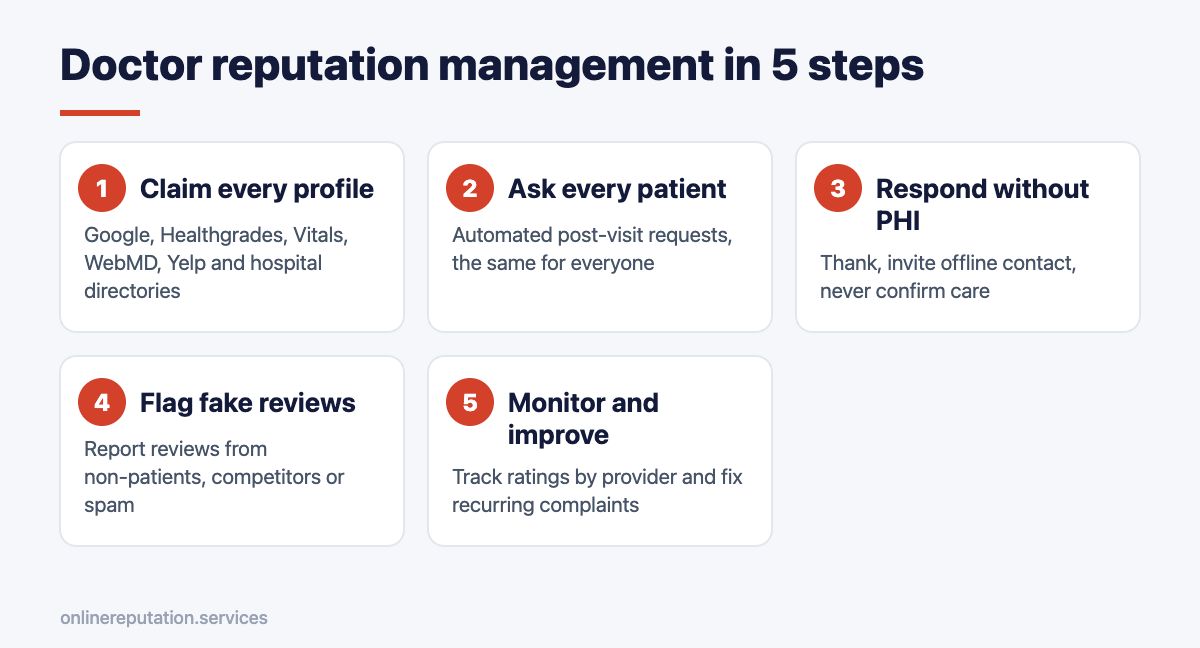
Why reputation matters so much for doctors
Choosing a doctor is a high-trust decision, and patients now make it online. They compare star ratings, read recent comments about wait times and bedside manner, and check whether a physician’s profile looks current. A handful of old, negative reviews on a thin profile can push new patients to a competitor, while a profile with hundreds of recent, mostly positive reviews does the opposite.
Physicians face rules most businesses do not. HIPAA limits what you can say publicly, medical boards care about advertising claims, and patients often review the individual doctor as well as the practice. That is why general marketing agencies sometimes get healthcare reputation wrong.
Step 1: Claim and fix every profile
Start by claiming and completing the profiles patients see most: Google Business Profiles for each location and, where appropriate, each provider; Healthgrades; Vitals; WebMD; Zocdoc if you use it; Yelp; and hospital or health-system directories. Make sure names, specialties, addresses, phone numbers, insurance accepted and photos are correct and consistent.
Inconsistent listings confuse patients and search engines and can split reviews across duplicate profiles. Listings management tools or a one-time cleanup can fix this.
Step 2: Ask every patient for a review
The single most effective tactic is a short text or email after each visit asking the patient to rate their experience. Most satisfied patients never think to leave a review unless asked, so a steady request flow quickly outweighs a few angry reviews.
Ask everyone the same way. Google’s policies prohibit selectively soliciting positive reviews, and the FTC’s rule on consumer reviews, effective October 21, 2024, prohibits suppressing negative reviews. It is fine to collect internal feedback, but every patient you invite to review must be able to post publicly.
Healthcare tools automate this by connecting to your EHR or practice management system. rater8 is built only for healthcare and publishes plans at $89 and $109 per physician per month; general platforms such as Birdeye and Podium also serve medical practices, and PatientTrak focuses on patient engagement.
Step 3: Respond to reviews without breaking HIPAA
Responding shows prospective patients that you listen, but HIPAA sharply limits what you can say. You cannot confirm that a reviewer is a patient, mention their visit, diagnosis or treatment, or share any details, even if the patient disclosed them first.
Regulators enforce this. In December 2022 the HHS Office for Civil Rights announced a $23,000 settlement with New Vision Dental in California over responses to Yelp reviews that disclosed patient names, treatment and insurance details, and OCR stated plainly that providers cannot disclose protected health information when responding to negative online reviews. Earlier actions included a $10,000 settlement with Elite Dental Associates in Dallas in 2019 and a $50,000 civil money penalty against a North Carolina dentist.
A HIPAA-safe response template
“Thank you for your feedback. We take every concern seriously and would welcome the chance to talk with you directly. Please call our practice manager at [phone] so we can help.”
Keep it short, generic and the same whether or not the reviewer was a patient. Thank positive reviewers in general terms, too.

Step 4: Deal with fake and policy-violating reviews
Doctors attract fake reviews from competitors, people who were never patients, disgruntled former employees and spam. Each platform lets you flag reviews that break its rules, such as conflicts of interest, off-topic rants, harassment or reviews of the wrong business. Document why the review breaks the policy and use the platform’s formal appeal if the first flag is rejected.
When flags fail, a removal specialist or attorney can help. Defamation Defenders handles policy-violating reviews with no upfront fee on pay-after-removal cases and re-handles a repost by the same reviewer within 30 days at no charge; Removify charges per removed review; and Minc Law can pursue defamatory reviews legally. Genuine negative reviews that follow the rules cannot be removed by anyone ethical.
Step 5: Monitor, measure and improve
Track ratings, review volume and recency by provider and location, and read the comments for patterns. Repeated complaints about wait times, billing or front-desk tone are operational problems, and fixing them is the most durable reputation strategy. See our best reputation monitoring services.
For high-profile physicians, also check the first page of Google for your name and what AI assistants say about you. Old news, lawsuits or board actions may need suppression or a professional bio that tells the full story.
Choosing a doctor reputation management service
| Option | Best for | Typical cost model |
|---|---|---|
| rater8 | Practices wanting automated, provider-level reviews | Per physician per month; free monitoring tier |
| Birdeye | Multi-location groups wanting reviews plus messaging and listings | Per location, quoted |
| Podium | Practices wanting reviews with texting and payments | Quoted by bundle |
| PatientTrak | Healthcare patient engagement | Quoted |
| Defamation Defenders | Removing fake or policy-violating reviews | Per item; pay-after-removal options |
| Reputation X | Physician search results and personal branding | Monthly retainer |
Before you sign, ask for the BAA if the vendor touches patient data, how patients are routed after a low rating, how providers are counted for billing, the contract term and cancellation terms, and whether removed reviews are re-handled at no cost if they come back. Compare more options on our best online review management companies page.
The review sites that matter most for doctors
| Site | Why it matters | What to do |
|---|---|---|
| The first place most patients look; ratings show in Maps and search | Claim each location and provider profile, add photos, respond to reviews | |
| Healthgrades | High-traffic physician directory with ratings and background details | Claim your profile, check education, board certifications and insurance |
| Vitals | Physician ratings and wait-time feedback | Claim and correct details; encourage reviews |
| WebMD | Large directory tied to health content | Verify your listing and specialties |
| Yelp | Strong in some cities and specialties | Claim the practice page; respond within policy |
| Zocdoc | Booking platform with verified-visit reviews | Keep availability current if you use it |
| Hospital directories | Patients often trust health-system pages | Ask your hospital to keep your profile current |
Check which of these rank on the first page for your name, your practice name, and your specialty plus city, and prioritize those.
Tips by specialty
Dentists and orthodontists
Dental practices see high review volume and frequent complaints about billing and insurance. Clear estimates, follow-up calls after major treatment and automated review requests make the biggest difference. Several HHS enforcement actions over review responses involved dental practices, so train staff carefully.
Plastic surgeons and aesthetic practices
Before-and-after expectations drive reviews. Photos, patient education and realistic consultations reduce unhappy reviews. These practices are also frequent targets of fake reviews, so monitor closely and document policy violations.
Mental health providers
Patients may be reluctant to post publicly, and responses carry extra privacy risk. Focus on accurate profiles, clear information about approach and insurance, and generic, compassionate replies that never confirm care.
Hospital-employed physicians
Your reputation sits partly on the health system’s pages. Work with the system’s marketing team on profile accuracy and review programs, and check whether its patient survey data feeds star ratings on its own site.
Urgent care and emergency medicine
Wait times dominate reviews. Post-visit requests from every patient, not just those seen quickly, and posting expected wait times online both help.
Responding to positive reviews
Positive reviews deserve a reply too, but the same HIPAA limits apply. Do not thank someone for coming in for a specific procedure or mention their condition. A short, generic thank-you that invites others to learn more about the practice is safe and shows patients you pay attention.
Billing, insurance and wait-time complaints
These are the most common complaints in healthcare reviews and the easiest to address operationally. Track them by location and provider, fix the underlying process, and mention improvements on your website rather than in replies to individual reviews. A professional, generic reply inviting the reviewer to contact your billing office is appropriate.
Advertising rules and testimonials
State medical boards regulate physician advertising, and many restrict misleading testimonials or guarantees of results. When you display reviews on your website, show genuine reviews without editing their meaning, do not cherry-pick in a misleading way, and follow the FTC’s rules on testimonials. If you offer anything to patients in connection with reviews, check both FTC rules and your board’s advertising rules first.
Metrics to track
- Average rating by provider and location on Google and the main healthcare sites.
- Number of new reviews per month and the share from the last 90 days.
- Response rate and response time.
- Share of reviews mentioning wait times, billing or staff attitude.
- Search position for each provider’s name and for your specialty plus city.
- What AI assistants say when asked to recommend a provider in your specialty and area.
Review these monthly and share them with providers. Many practices find that visible, friendly competition between providers raises review volume on its own.
Building a strong online presence for each provider
Patients search for the individual doctor as often as the practice. Every provider should have a complete, accurate profile on the practice website with a professional photo, education, board certifications, specialties, languages, insurance accepted and a short personal statement. Link that page from Google Business Profiles and healthcare directories, and keep it current when anything changes.
Physicians who write, speak or teach can add bylined articles, conference talks and university or hospital pages. These help the first page of results for a doctor’s name stay positive, and they give AI assistants accurate sources to draw on.
Training staff on reviews
Front-desk and clinical staff shape most of the experiences patients write about, so they need to be part of the program. Train them to mention that patients will receive a short feedback request after their visit, to flag unhappy patients to a manager before they leave, and never to post or reply to reviews themselves. Write a short policy that covers who responds to reviews, which template to use, and when to escalate to the practice manager, compliance or legal.
When to bring in outside help
Most practices can run a solid program with software and a clear policy. Outside help makes sense when a practice has many providers or locations, when fake reviews keep appearing, when a provider faces news coverage, lawsuits or board actions that rank for their name, or when staff do not have time to manage reviews consistently. Compare options on our best online review management companies page.
Frequently asked questions
What is doctor reputation management?
It is the work of improving a physician’s or practice’s online reviews, search results and profiles: getting more reviews from real patients, responding within HIPAA, removing fake reviews and keeping listings accurate.
Can a doctor respond to a negative review?
Yes, but only in general terms. Do not confirm the person is a patient or mention any details of their care. Invite them to contact the practice directly instead.
Can doctors get negative reviews removed?
Only reviews that break the platform’s rules, such as fake reviews, reviews from non-patients or harassment, can be removed. Flag them with the platform first, then use a removal specialist or attorney if needed.
Is it legal to ask patients for reviews?
Yes. Asking every patient for a review is legal and encouraged. Offering incentives for positive reviews, or only inviting happy patients, breaks platform rules and the FTC’s review rule.
How much does doctor reputation management cost?
Review software typically costs about $89 to a few hundred dollars per provider or location per month. Removal is priced per review, and suppression or branding runs on a monthly retainer.
Which review sites matter most for doctors?
Google is the most visible, followed by Healthgrades, Vitals, WebMD and Yelp, plus Zocdoc and hospital directories where relevant. Check which sites rank for your name and specialty in your city.
Do AI assistants affect a doctor’s reputation?
Increasingly, yes. Patients ask ChatGPT and Google’s AI Overviews for doctor recommendations, and those answers draw on reviews and profiles, so accurate, well-reviewed listings help there too.
How many reviews does a doctor need?
There is no fixed number, but recency matters. Patients trust profiles with a steady flow of recent reviews more than a high rating built on a few old ones. Aim for new reviews every month for each provider.
Can a doctor sue a patient over a negative review?
Only if the review contains false statements of fact that meet the legal standard for defamation, and lawsuits can backfire. Opinions and accurate accounts are generally protected. Talk to a lawyer and consider the HIPAA implications before acting.
Should practices use review gating?
No. Sending only satisfied patients to public review sites breaks Google’s policies and the FTC’s rule against review suppression. Invite every patient the same way and use internal feedback for service recovery.
Should doctors respond to every review?
Responding to most reviews, positive and negative, shows patients you are attentive. Keep every reply short, generic and HIPAA-safe, and skip replies to reviews that are abusive or likely fake while you report them.
Can a practice remove reviews from former employees?
Often, yes. Most platforms prohibit conflict-of-interest reviews, including reviews from current or former employees posing as patients. Report them with any evidence you have.
How quickly should a practice respond to a negative review?
Within a few business days is a good standard. A fast, calm reply reassures prospective patients, while a delayed or defensive one can make the review more damaging.
Related guides and comparisons
- How much does reputation management cost?
- Best online review management companies
- Best reputation monitoring services
- rater8 review
- Types of online reputation management
Not sure which company fits? Tell us what you are dealing with and we will suggest two or three providers that fit the problem and your budget. Get a free shortlist.
Sources: HHS Office for Civil Rights announcements and resolution agreements (New Vision Dental, 2022; Elite Dental Associates, 2019), the FTC Trade Regulation Rule on the Use of Consumer Reviews and Testimonials, Google review policies, and ORS company reviews; see also this infographic on ORM and SEO; checked November 2026. Company details and third-party ratings change; confirm current terms with any provider before you buy.