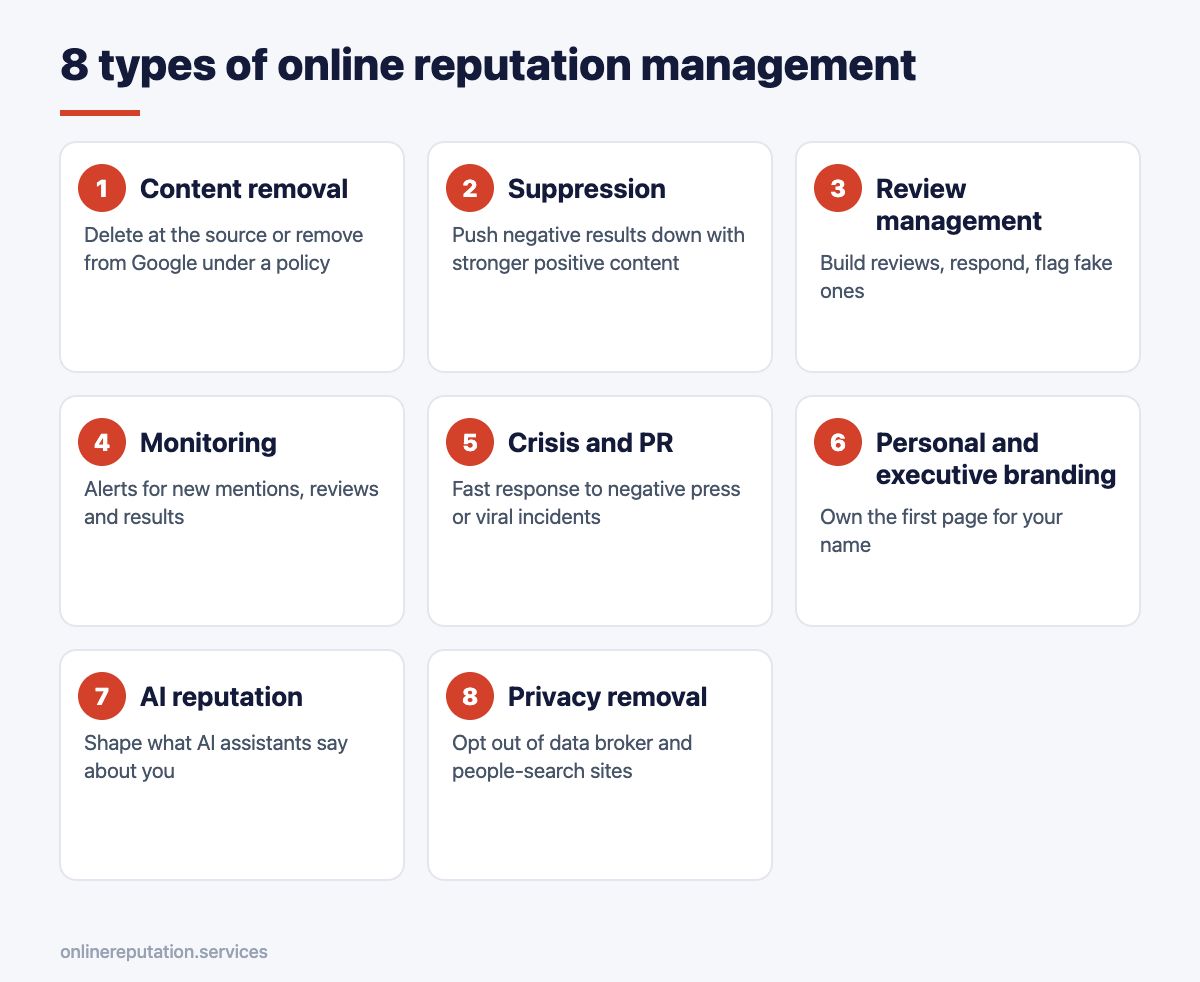
There are eight main types of online reputation management (ORM): content removal, search result suppression, review management, reputation monitoring, crisis and PR response, personal and executive branding, AI reputation management, and privacy and data broker removal. Most problems need one or two of these, not all eight. The right type depends on whether the harmful content can legally be removed, whether it is accurate, and whether the goal is fixing a single result or building a lasting reputation.
Last updated November 23, 2026. Researched and reviewed by Peter Anderson for Online Reputation Services.
Key takeaways
- Removal deletes content at the source or from search; suppression only pushes it down. Try removal first when a route exists.
- Review management builds new reviews and handles responses; it cannot legally delete genuine negative reviews.
- Monitoring is cheap insurance: it catches new problems while they are still easy to fix.
- AI reputation management is now its own category because ChatGPT, Gemini and Google AI Overviews summarize what the web says about you.
- Ask every provider which type of work they are proposing, how a result is defined and what happens if content comes back.
What online reputation management covers
Online reputation management is the work of changing what people find when they search for a person, business or brand. That usually means Google results for a name, review profiles on Google, Yelp and industry sites, social media, news coverage and, increasingly, the answers AI assistants give when someone asks about you.
The industry sells very different services under the same label. A company that removes a mugshot, an agency that publishes positive articles for a year, and software that texts customers for reviews are all called reputation management. Knowing the types helps you buy the right one and avoid paying for months of work that does not address your actual problem.
1. Content removal
Content removal gets negative material taken down at the source or removed from search results. It works when the content breaks a site’s rules or a search engine policy, is defamatory or unlawful, is a copyright violation, or appears on a site that will remove it on request. Common targets include mugshots and arrest records, court-record aggregator pages, fake reviews, defamatory posts, doxxing and non-consensual images.
Google runs several removal policies of its own. For example, since 2018 it has let people request removal of pages on sites that charge to remove content, and its Results about you tool finds and removes listings that show your phone number, address or email.
Removal is usually the fastest and cheapest fix when a route exists, and the result is permanent if it holds. Providers in this category include Defamation Defenders, Erase.com, Guaranteed Removals and law firms such as Minc Law when a court order is needed. Compare them on our best content removal companies page.
2. Search result suppression
Suppression, sometimes called reverse SEO, pushes a negative result off the first page by building and ranking stronger positive content: personal websites, profiles, press, articles and social accounts. It is the fallback for accurate, newsworthy content that a publisher will not remove, such as legitimate news coverage.
Suppression takes months, typically runs on a monthly retainer and is never fully permanent, because the negative page still exists and can climb back. It works best when there are only a few negative results and the name is not highly competitive. See our best search result suppression companies.

3. Review management
Review management covers getting more reviews from real customers, responding to reviews, monitoring ratings across sites and flagging fake or policy-violating reviews. Software such as Birdeye, Podium, ReviewTrackers and, for medical practices, rater8 automates the requests and dashboards.
Two rules matter. First, genuine negative reviews that follow a platform’s rules cannot be removed by any ethical provider. Second, the FTC’s rule on consumer reviews, in force since October 21, 2024, bans fake reviews, buying reviews and suppressing negative ones, with civil penalties for knowing violators. Selectively asking only happy customers for reviews also breaks Google’s policies. Compare tools on our best online review management companies page.
4. Reputation monitoring
Monitoring tracks new reviews, mentions, search results and social posts so you can respond early. It ranges from free Google Alerts and Google’s Results about you to paid dashboards that cover review sites, news, social media and search rankings for a name.
Monitoring does not fix anything by itself, but it is the cheapest way to avoid a bigger bill later. A fake review answered or flagged in its first week, or a new people-search listing removed before it ranks, costs far less than a suppression campaign. See our best reputation monitoring services.
5. Crisis management and PR
Crisis work handles negative press, viral social media posts, lawsuits and data breaches as they happen. It combines communications strategy, statements, media relations, legal coordination and search and social monitoring. Speed matters most: the first 48 hours shape the coverage that ranks for years.
Crisis firms are usually the most expensive option and are priced like PR agencies. Use them when the story is active; once coverage settles, the work shifts to removal where possible and suppression where not. See our best reputation crisis management companies.
6. Personal and executive branding
Branding builds a strong first page for a person’s name before anything goes wrong: a personal website, complete professional profiles, published articles, speaking pages and interviews. For executives, founders and public figures, it also covers Wikipedia accuracy, knowledge panels and leadership profiles.
It is the most durable defense, because a name with ten strong, accurate results is much harder for a single negative page to break into. See our best personal reputation management services and best executive reputation management companies.
7. AI reputation management
AI reputation management is the newest category. ChatGPT, Gemini, Perplexity, Copilot and Google’s AI Overviews now summarize what the web says about people and companies, sometimes repeating old or wrong information. AI reputation work audits those answers, corrects the sources the models rely on, publishes clear and accurate information they can cite, and monitors changes over time.
No provider can guarantee what an AI system says, because the models change and draw on many sources. Treat any promise to control AI answers with caution, and ask for a before-and-after audit of the specific prompts that matter to you. OptimizeUp and Reputation X are among the providers that offer AI visibility work.
8. Privacy and data broker removal
Privacy removal opts you out of data broker and people-search sites that publish your address, phone number, relatives and age. It is often sold as a subscription because brokers re-list people after a few months.
You can do it yourself with each site’s opt-out form and Google’s Results about you, but there are hundreds of brokers. Services such as RemoveOnlineInformation.com (removeonlineinformation.com) and Defamation Defenders’ monitoring plan handle the opt-outs and re-check for re-listings.
How to choose the right type
| Your problem | Start with | Usually add |
|---|---|---|
| A mugshot, court record or fake review | Content removal | Monitoring |
| Accurate news article that will not come down | Suppression | Branding, AI reputation |
| Too few or poor reviews | Review management | Monitoring |
| Active negative story or viral post | Crisis and PR | Removal or suppression later |
| Address and phone number online | Privacy removal | Monitoring |
| Wrong or outdated AI answers | AI reputation management | Branding |
| Nothing wrong yet, high-profile role | Branding | Monitoring |
Before you hire anyone, ask which type of work each line of the proposal is, how a completed result is defined, what triggers payment, and what happens if removed content comes back or is reposted at a new URL. A good provider will tell you when a cheaper type of work, or doing it yourself, will solve the problem.
If you want to compare providers across all of these categories, start with our reputation management company rankings.
Signs you need reputation management
Not every bad review or old article needs professional help. These are the signs that it is worth acting:
- A negative result appears on the first page of Google for your name or business name.
- Prospects, employers, landlords or partners have mentioned something they found online.
- Your star rating has dropped, or a competitor has far more recent reviews.
- Your address, phone number or family details appear on people-search sites.
- AI assistants such as ChatGPT or Google’s AI Overviews describe you or your company inaccurately.
- A news story, lawsuit or viral post is spreading and you have no plan to respond.
If none of these apply, a simple monitoring setup is usually enough. If one or more does, match the problem to the right type of reputation management above.
How a typical reputation management engagement works
Whatever the type, a well-run engagement follows a similar path:
- Audit. The provider maps your search results, reviews, profiles, data broker listings and AI answers, and labels each problem by type.
- Plan. You get a written proposal that says which items will be removed, de-indexed or suppressed, which reviews will be built or flagged, and the timeline and cost of each.
- Quick wins. Removals, Google requests, profile fixes and review responses usually come first because they are fast and cheap.
- Longer work. Suppression, branding, review generation and AI reputation work run for months.
- Reporting. Monthly reports should show rankings, removals, review metrics and AI answers, not just a list of activities.
- Maintenance. Monitoring and occasional new content keep results stable after the main project ends.
Ask any provider to walk you through these stages for your situation before you sign.
Doing it yourself vs. hiring a provider
| Task | Do it yourself | Hire help when |
|---|---|---|
| Opt out of data brokers | Free but slow; repeat every few months | There are dozens of listings or you want ongoing monitoring |
| Ask for Google removals | Free through Google’s request forms | Requests are rejected or the content needs a legal basis |
| Respond to reviews | Easy with a simple policy | Volume is high or HIPAA and legal risks apply |
| Get more reviews | Possible with manual requests | You have many locations or providers to manage |
| Remove mugshots or court records | Possible site by site | There are many copies or sites ignore requests |
| Suppress a news article | Very hard without content and SEO skills | Almost always; it takes sustained work |
| Manage a crisis | Not recommended | Immediately |
A good provider will tell you which of these you can handle yourself. Be cautious of anyone who wants to charge for work that free tools already do.
Choosing between agencies, software and specialists
Reputation management companies fall into four broad groups. Managed agencies such as Reputation X and Status Labs handle suppression, PR and branding for you. Review platforms such as Birdeye and Podium give you software to run review programs yourself. Removal specialists such as Defamation Defenders focus on taking specific content down. Law firms such as Minc Law handle court orders and defamation claims.
Many people need more than one. A common combination is a removal specialist for items that can come down, followed by a suppression or branding program for anything that remains. Compare providers in each group on our reputation management company rankings.
Reputation management in the age of AI search
Search is changing. Google’s AI Overviews, ChatGPT, Gemini, Perplexity and Copilot now answer questions about people and companies directly, often without the searcher clicking any link. Those answers draw on the same sources that rank in search: news, review sites, directories, Wikipedia, social profiles and company websites.
That changes how each type of reputation management works. Removing or correcting a source can change AI answers as well as search results. Suppression needs authoritative, well-cited content, not thin pages. Review programs feed the ratings that AI assistants quote. And monitoring now means checking what the main assistants say about you every month, alongside your Google results.
Frequently asked questions
What are the main types of online reputation management?
The main types are content removal, search result suppression, review management, reputation monitoring, crisis management and PR, personal and executive branding, AI reputation management, and privacy or data broker removal.
What is the difference between removal and suppression?
Removal deletes content at the source or gets it removed from search results under a policy or law. Suppression leaves the content online but pushes it down the results with stronger positive pages. Removal is usually faster and permanent; suppression is slower and needs maintenance.
Which type of reputation management do I need?
Start with what the problem is. Removable content such as a mugshot or fake review calls for removal; accurate news calls for suppression; a thin review profile calls for review management; an active story calls for crisis help.
Can reputation management remove negative reviews?
Only reviews that break the platform’s rules, such as fake, spam, conflict-of-interest or harassing reviews, can be removed. Genuine negative reviews cannot be removed ethically; respond professionally and build new reviews instead.
How much does online reputation management cost?
It depends on the type. Removal is often priced per item, suppression and branding run monthly retainers, review software is a monthly subscription, and crisis work is priced like PR. See our guide to reputation management costs.
Is AI reputation management real?
Yes. It focuses on what AI assistants and Google’s AI Overviews say about you and works by correcting and strengthening the sources those systems cite. No one can guarantee AI answers, so judge providers on audits and measured changes.
Can I do reputation management myself?
Often, yes. You can request removals through Google’s tools, opt out of data brokers, respond to reviews and build profiles yourself. Professional help is most useful for complex removals, suppression and crises.
How long does online reputation management take?
Removals and Google requests can take days to weeks. Review programs show results within weeks. Suppression and branding usually take three to twelve months.
Is online reputation management legal?
Yes, when it uses legitimate methods: removal under platform rules or the law, honest review requests, accurate content and real PR. Fake reviews, false legal claims and impersonation are illegal or against platform rules.
What is the most common type of reputation management?
For businesses, review management is the most common. For individuals, removal of personal information, mugshots and old articles, and suppression of results that cannot be removed, are the most common.
Do I need reputation management if I have no negative results?
Not urgently, but building a strong first page and setting up monitoring now makes any future problem much easier and cheaper to handle.
Related guides and comparisons
- How much does reputation management cost?
- Best content removal companies
- Best search result suppression companies
- Best online review management companies
- Reputation management company rankings
Not sure which company fits? Tell us what you are dealing with and we will suggest two or three providers that fit the problem and your budget. Get a free shortlist.
Sources: Google Search Help (removal policies and Results about you), the FTC Trade Regulation Rule on the Use of Consumer Reviews and Testimonials (16 CFR Part 465), and provider websites and ORS company reviews, checked November 2026. Company details and third-party ratings change; confirm current terms with any provider before you buy.