

Reputation.com review
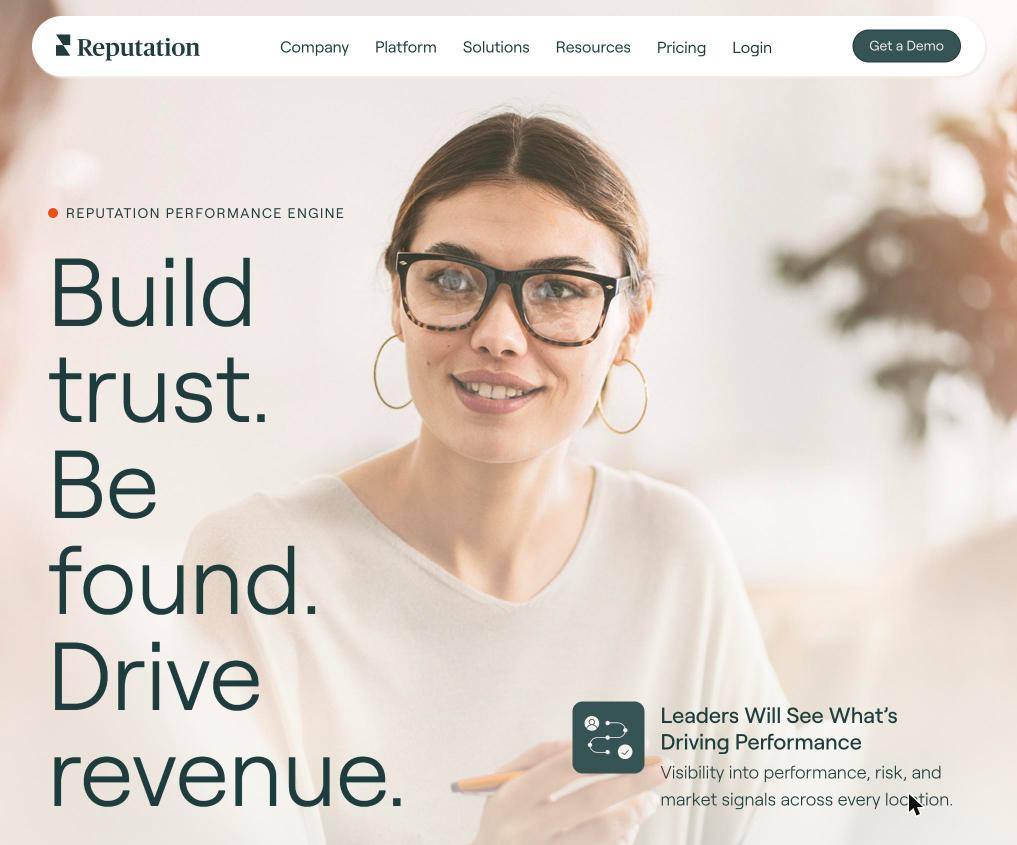
Reputation.com review (2026): Reputation.com, which now goes by Reputation, is an enterprise software platform for managing reviews, business listings, surveys and social for brands with many locations. It suits multi-location companies in fields like automotive, healthcare, real estate and property management that want one dashboard and AI analytics. It is not a service for individuals who want a news article, mugshot or fake review taken down, and its pricing is custom quoted.
Last reviewed November 22, 2026. Reviewed by Peter Anderson. This review is based on public research: the company’s own website and terms, third-party rating sites and published coverage. Online Reputation Services was not a paying client of Reputation.com, and Reputation.com did not pay for this review or its placement.
Is Reputation.com legit? The short answer
Yes. Reputation.com is a long-established, venture-backed software company, not a fly-by-night agency. It was founded in 2006 by Michael Fertik as ReputationDefender and renamed Reputation.com in 2011 when it moved its focus to business customers. In 2018 it sold the consumer ReputationDefender brand, which is now a separate business, and it kept the enterprise platform under the Reputation name.
Third-party data supports that it is a real, sizeable operation. LinkedIn lists 501-1,000 employees and a San Ramon, California headquarters. Company and press materials name Joe Burton as CEO, and funding trackers report roughly $267 million raised. On rating sites, the picture splits by audience. G2 shows about 4.6 out of 5 from roughly 2,470 reviews, most of them from marketing and operations staff at mid-market and enterprise customers. Trustpilot shows 3.3 out of 5 from 97 reviews, with only a handful posted in the past year and several complaints about billing and support.
So the honest answer to “is Reputation.com legit” is yes, as an enterprise software vendor. The more useful question is whether it fits what you need, because a lot of people who search for the brand are individuals looking for content removal, and that is a different product category.
Reputation.com at a glance
| Founded | 2006 (as ReputationDefender); renamed Reputation.com in 2011 |
|---|---|
| HQ | 6111 Bollinger Canyon Road, Suite 500, San Ramon, CA 94583 |
| Phone | (800) 888-0924 (sales line listed by third-party directories; the website routes most contact through demo forms) |
| Core services | Review management, listings management, surveys, social, local pages, AI analytics (Reputation IQ), competitive insights, managed Reputation Services |
| Pricing model | Custom annual SaaS subscription, usually priced per location; demo required; no public price list |
| Guarantee | No results guarantee published; terms are set in the order form |
| Best for | Multi-location brands with 10 to thousands of locations |
| Third-party ratings | G2 about 4.6/5 (about 2,470 reviews); Trustpilot 3.3/5 (97 reviews); checked November 2026 |
What Reputation.com does: services
Reputation sells a set of modules that sit on one platform. Most customers license a bundle rather than a single tool, and the company also offers managed help for teams that don’t want to run the software themselves. Here is what each part covers, based on the company’s site and user reviews.
Review management (Reviews and Review Booster)
The Reviews module pulls ratings and reviews from Google, Facebook, Yelp, industry sites such as Cars.com, DealerRater and Healthgrades, and many others into one feed. Teams can reply from the dashboard with templates or AI-drafted responses, route reviews to the right location manager and track response times. Review Booster sends review requests by text or email after a purchase or visit to increase review volume. It does not remove reviews from third-party sites. If a review breaks a site’s policy, your team still has to flag it through that site’s own process.
Listings management
Listings keeps business name, address, phone, hours and categories consistent across Google Business Profile, Apple Maps, Bing, Facebook and directory networks. For brands with hundreds of locations, this is often the module that pays for itself first, because a wrong phone number or closed-location listing costs real customers.
Surveys and customer experience
Surveys collects first-party feedback such as NPS and post-visit questionnaires and lets teams compare it with public reviews. Reputation positions this as customer experience management rather than pure reputation management, and case studies on its site cite NPS changes for retail and property clients.
Social and local pages
Social lets teams publish and monitor across social accounts for many locations. Pages creates location landing pages, and the company now markets them as content that AI engines can read when they answer local questions.
Reputation IQ, Insights and Rep Score
The analytics layer groups review text into themes, flags sentiment trends and lets users ask plain-language questions about their feedback data. Rep Score is the company’s single reputation KPI. User reviews say it is useful for benchmarking locations, though some customers question how the score weights negative reviews.
Reputation Services (managed)
For teams short on staff, Reputation offers managed services in which its people set up the platform, write responses and run programs. This is still platform-led work for brands. It is not legal takedown or search suppression for a person.
How Reputation.com works: step by step
Reputation sells like most enterprise software: a sales-led process, an annual contract and an onboarding project. Here is the typical path, based on the company’s published materials and user reviews.
- Demo request. You fill in the demo form or call sales. A rep asks about location count, industry, the review sites that matter to you and your current tools.
- Discovery and audit. Reputation often prepares a baseline report, such as a Rep Score snapshot or its free GEO Readiness Report, which shows how listings and reviews look across your locations.
- Proposal and order form. You receive a quote for the modules and location count. The order form sets the contract term (commonly 12 months or longer), payment schedule and renewal terms.
- Payment. Enterprise SaaS is usually invoiced annually or quarterly in advance. Confirm this in your order form, because terms vary by deal.
- Onboarding. The team connects your locations, claims or syncs listings, links review sources and sets up user roles. Large rollouts can take several weeks.
- Ongoing use and reporting. Your team, or Reputation Services if you buy it, responds to reviews, runs review requests and surveys, and watches dashboards and Rep Score trends.
- Renewal. Contracts typically auto-renew unless you give notice. Diarize the notice window as soon as you sign.
How much does Reputation.com cost?
Reputation does not publish prices. G2, Capterra and GetApp all list it as “contact vendor for pricing,” and the main call to action on its site is a demo request. That is normal for enterprise platforms, but it means you cannot compare cost until you are in a sales process.
What drives the price is predictable: the number of locations, which modules you bundle (reviews only versus reviews plus listings, surveys and social), whether you add managed services, and contract length. Multi-year commitments and larger location counts usually lower the per-location rate.
Get these in writing before you sign: the per-location rate and the total annual cost, any onboarding or setup fee, what happens if you add or close locations mid-term, the auto-renewal date and notice period, and data-export rights if you leave.
Example cost scenarios
These are estimates to help you budget, not quotes from Reputation. They assume the per-location annual pricing model described above. Your actual price will depend on modules and negotiation.
- A 12-location dental group wanting reviews and listings: expect a mid-four to low-five-figure annual contract. At that size, also price SMB-focused tools such as Birdeye or Podium, which may be cheaper per location.
- A 300-location auto or property brand on the full suite: expect a six-figure annual agreement, with per-location rates falling as volume rises. Negotiate onboarding and a pilot region before committing the whole portfolio.
- One person who wants a negative news article or fake review gone: Reputation is not built for this, so there’s no meaningful price. A content removal firm typically quotes per URL, and a suppression campaign is usually a monthly retainer.
Reputation.com pros and cons
Pros
- Deep multi-location tooling: reviews, listings, surveys and social in one platform with role-based access by region and location.
- Very large base of verified G2 reviews (about 2,470) with a high average, which gives buyers real signal.
- Strong industry fit in automotive, healthcare, real estate and multifamily, with integrations for review sites in those verticals.
- Active investment in AI analytics and AI-search visibility, including Reputation IQ and location pages.
Cons
- No public pricing, and contracts are typically annual or longer.
- Not a removal or suppression service for individuals, which surprises many people who search for the brand name.
- Trustpilot reviews (3.3/5 from 97) include complaints about billing, refunds and slow support tickets.
- Some users find the Rep Score methodology hard to interpret, and the platform can be more than a small business needs.
Reputation.com reviews: what customers and rating sites say
The two biggest rating sites tell different stories because they reach different reviewers. On G2, where reviewers are mostly verified platform users, Reputation averages about 4.6 out of 5 from roughly 2,470 reviews (checked November 2026). Common praise is that it pulls reviews from many sites into one inbox, makes replies faster with templates and AI drafts, and helps regional managers see which locations need attention. Recurring criticism on G2 centers on occasional sync glitches, reporting that takes time to configure and a learning curve for new users. Capterra users are broadly positive too, with roughly 90% of review sentiment rated positive in its summary.
Trustpilot is more mixed: 3.3 out of 5 from 97 reviews, but only about six posted in the last 12 months. Trustpilot notes the company hasn’t recently invited reviews and hasn’t replied to negative ones. The negative reviews describe slow ticket resolution, billing disputes and frustration with how one-star reviews affect scores. Some older complaints appear to come from consumers who confused the company with the ReputationDefender consumer service it used to own. We’d weigh the G2 data more heavily for a platform buying decision, and treat the Trustpilot complaints as a reason to read the contract carefully.
We did not find a meaningful Better Business Bureau rating history to report, so we have left BBB status blank rather than guess.
Who Reputation.com is best for (and who should look elsewhere)
Reputation is best for marketing, CX and operations teams at multi-location brands: car dealer groups, hospital systems, property managers, franchises, retailers and restaurant chains. It earns its cost when you have enough locations that manual review replies and listing updates break down, and when leadership wants one score to compare regions.
Look elsewhere if you are an individual, a single-location business, or someone dealing with a specific harmful URL. A small business with one or two locations will usually get better value from a lighter review tool. Anyone who needs a defamatory article, mugshot, court record or policy-violating review taken down needs a removal firm, and someone who needs page-one Google results rebuilt needs a suppression or personal ORM agency. Reputation’s software can help you respond to reviews, but it cannot make a publisher delete content.
Reputation.com vs. competitors
Reputation.com vs Birdeye
Both are review and listings platforms for local businesses. Birdeye leans toward small and mid-sized businesses and publishes more plan information, while Reputation is built around enterprise reporting, survey data and large location counts. Birdeye has more G2 reviews overall. If you have under about 50 locations, get quotes from both, since Birdeye is often easier to start with. Above a few hundred locations, Reputation’s governance and analytics tend to matter more.
Reputation.com vs Podium
Podium is a messaging-first tool. It is strongest at texting customers, collecting payments and getting review requests out from the front desk. Reputation is analytics-first and covers listings, surveys and social more deeply. A single-location service business that mainly wants more Google reviews may prefer Podium. A brand that needs to report on sentiment across hundreds of sites will prefer Reputation.
Reputation.com vs ReputationDefender
These two share an origin but are separate companies today. ReputationDefender is the consumer and executive privacy and search-results service that Reputation.com sold in 2018. It works for people, not locations. If you’re searching “Reputation.com” because something negative about you personally shows up on Google, ReputationDefender or a removal firm is the right comparison, not the Reputation platform.
Red flags to watch for (and how to vet Reputation.com)
Reputation is an established vendor, so the risks are mostly contract risks rather than legitimacy risks. Check these before you sign.
- Auto-renewal and notice periods. Find the renewal date and the cancellation notice window in the order form, and put both on a calendar.
- Location changes. Ask how adding, closing or selling locations mid-term changes your bill.
- Onboarding scope. Get a written onboarding plan with milestones, so you aren’t paying for licenses you can’t use yet.
- Score definitions. If Rep Score will be a KPI for your managers, ask for the methodology in writing before you tie bonuses to it.
- Review solicitation rules. Make sure the way you request reviews complies with Google’s policies and the FTC’s 2024 rule on fake and incentivized reviews. Never gate or buy reviews.
- Data export. Confirm you can export your review, response and survey history if you leave.
Reputation.com alternatives
| Provider | Best for | How it differs |
|---|---|---|
| Birdeye | Small and mid-sized multi-location businesses | Simpler to start, broad SMB feature set; often less enterprise reporting depth |
| Podium | Single and few-location service businesses | Messaging-first: texting, payments and review requests from the front desk |
| ReviewTrackers | Brands focused on review analytics | Narrower focus on review monitoring and insights |
| ReputationDefender | Individuals and executives | Consumer privacy and search-result work; separate company since 2018 |
| Defamation Defenders | Removing specific harmful URLs | Removal-first service with a money-back guarantee on agreed removals (Defamation Defenders shares ownership with Online Reputation Services.) |
For more platforms like this, see our best online review management companies and business reputation management rankings, or browse the full reputation management service rankings.
Questions to ask Reputation.com before you sign
- What is the per-location annual price for the exact modules we need, and what is the total contract value including onboarding?
- How much notice do we need to give to avoid auto-renewal, and can we reduce the location count at renewal?
- If removed content comes back or is reposted at a new URL, will you remove it again at no additional cost, and how long does that warranty last?
- Which outcome triggers payment: a removal at the source, a search-engine de-index, or reduced visibility?
Reputation.com FAQs
Is Reputation.com legit?
Yes. Reputation.com, now branded Reputation, has operated since 2006, employs several hundred people and has about 2,470 reviews on G2 averaging around 4.6 out of 5. It is a legitimate enterprise software company. Whether it is right for you depends on whether you need multi-location review software or help with specific harmful content.
How much does Reputation.com cost?
Reputation does not publish pricing. It sells custom annual subscriptions, typically priced by location count and modules, after a demo. Small multi-location businesses should expect a meaningful annual commitment, and large brands can reach six figures a year.
Does Reputation.com offer a guarantee or refunds?
There is no public results guarantee. Refund and cancellation rights come from your order form and master agreement, so read the term, renewal and termination clauses before you sign.
Can Reputation.com remove bad reviews?
Not directly. The platform helps you monitor, respond to and request reviews, and you can flag policy-violating reviews to the review site. Only the site itself, or a court order in some cases, can remove a review.
Can Reputation.com remove a news article or mugshot about me?
No. That is content removal or suppression work for individuals, which Reputation does not sell. Look at removal firms or personal reputation management companies instead.
Is Reputation.com the same as ReputationDefender?
They share a founder and history but are separate businesses today. ReputationDefender’s consumer business was sold in 2018 and later became part of Gen Digital, the NortonLifeLock parent company. Reputation kept the enterprise platform.
How long does Reputation.com take to set up?
It depends on location count and modules. A small rollout can go live in a few weeks, while a large brand with hundreds of locations may run a phased onboarding over one to three months.
Is there a Reputation.com contract, and can I cancel?
Yes, it is typically a 12-month or longer subscription that auto-renews. Cancellation usually requires written notice before the renewal date, as specified in your order form.
Who owns and runs Reputation.com?
Reputation is a privately held, venture-backed company. Joe Burton is CEO, and founder Michael Fertik has served as executive chairman.
Where is Reputation.com located?
Its headquarters is in San Ramon, California (6111 Bollinger Canyon Road). It also has offices internationally, including in India, Germany and Australia, according to company and job-listing information.
What is the difference between review management and suppression?
Review management, which is what Reputation does, means monitoring, replying to and generating reviews on review sites. Suppression means pushing harmful search results lower by ranking positive content above them. Removal means getting the source content deleted or de-indexed. They are different services with different pricing.
Is my data private with Reputation.com?
Reputation processes customer review and survey data under its privacy policy and your contract. Enterprise buyers, especially in healthcare, should ask for its security documentation and any HIPAA or data-processing agreements during procurement.
Does Reputation.com work for a single-location business?
It can, but it is built and priced for brands with many locations. A single-location business usually gets better value from a lighter review tool or from Google Business Profile’s free features, unless it plans to add locations soon.
Our verdict on Reputation.com
Reputation.com is a credible, mature platform for brands that manage reviews, listings and customer feedback across many locations. Its G2 track record is strong, its AI and analytics roadmap is active, and its industry fit in automotive, healthcare and real estate is real. The trade-offs are opaque pricing, annual contracts and mixed Trustpilot feedback on billing and support, so negotiate carefully and read the renewal terms.
If you’re an individual or a small business trying to get a specific article, review or record off the internet, Reputation is the wrong tool. Use our shortlist form or the rankings above to find a removal or suppression provider instead.
Sources: Reputation.com website and leadership page; Wikipedia; LinkedIn company page; CB Insights; G2 and Capterra product pages; Trustpilot (reputation.com); Everything-PR firm profile. Checked November 22, 2026. Ratings and review counts change; check the live profiles before you buy.
Comparing providers? Get a free shortlist.
Tell us what you’re dealing with. We’ll suggest 2–3 providers that fit the problem and your budget, with no obligation.






Write a review of Reputation.com