

Birdeye review
Verdict: Birdeye is one of the most widely used review and customer-experience platforms for multi-location businesses, with more than 4,000 reviews on G2 averaging 4.7. It is strong at automating review requests, managing listings, messaging customers and, increasingly, improving how brands show up in AI search through its “AI Coworkers.” It is also expensive (reported plans run about $299 to $449 per location per month on annual contracts), and contract and cancellation terms are the most common complaint. It does not remove reviews or articles.
Reviewed by Peter Anderson. Last updated November 23, 2026. This review is based on research: we read Birdeye’s website and pricing page, its own pricing blog, user reviews on G2, Capterra and Software Advice, and independent pricing breakdowns, and compared it with other platforms and reputation firms we cover. We did not buy a Birdeye subscription. Online Reputation Services is run by people who also operate reputation businesses, including Defamation Defenders, which is compared below; we disclose that so you can weigh our comparisons.
Is Birdeye legit?
Yes. Birdeye is a large, venture-backed software company founded in 2012 and based in Palo Alto, California, led by co-founder and CEO Naveen Gupta. Its clients listed on its homepage include JLL, Weill Cornell Medicine, Orkin, Jiffy Lube, Extra Space Storage, Six Flags, Cracker Barrel, Caesars Entertainment and David’s Bridal. It has teams in the US, UK, Australia and India.
It also has one of the largest review footprints in its category. G2 shows Birdeye at 4.7 out of 5 from more than 4,000 reviews, and Birdeye promotes itself as “#1 on G2.” Software Advice lists more than 700 reviews, with user-friendliness and review request automation as the main pros and contract and cancellation as the main con.
So the platform is legitimate and widely used. The things to check before buying are price, contract length and cancellation terms, not whether the company is real.
Birdeye at a glance
| Detail | Birdeye |
|---|---|
| Website | birdeye.com |
| Headquarters | 2479 E. Bayshore Rd., Suite 188, Palo Alto, CA 94303 |
| Founded | 2012 |
| Leadership | Naveen Gupta (Co-Founder & CEO); Neeraj Gupta (Co-Founder) |
| Team size | 1,000+ (company-reported) |
| Phone | 1-800-561-3357 |
| Product type | Review, listings, messaging, social and AI customer-experience platform (SaaS) |
| Positioning | “AI Coworkers for Multi-location Brands” |
| Plans | Starter, Growth, Dominate; custom pricing for larger brands |
| Reported pricing | About $299–$449 per location per month, billed annually |
| G2 rating | 4.7/5 from 4,000+ reviews |
| Removal services | None |
What does Birdeye do?
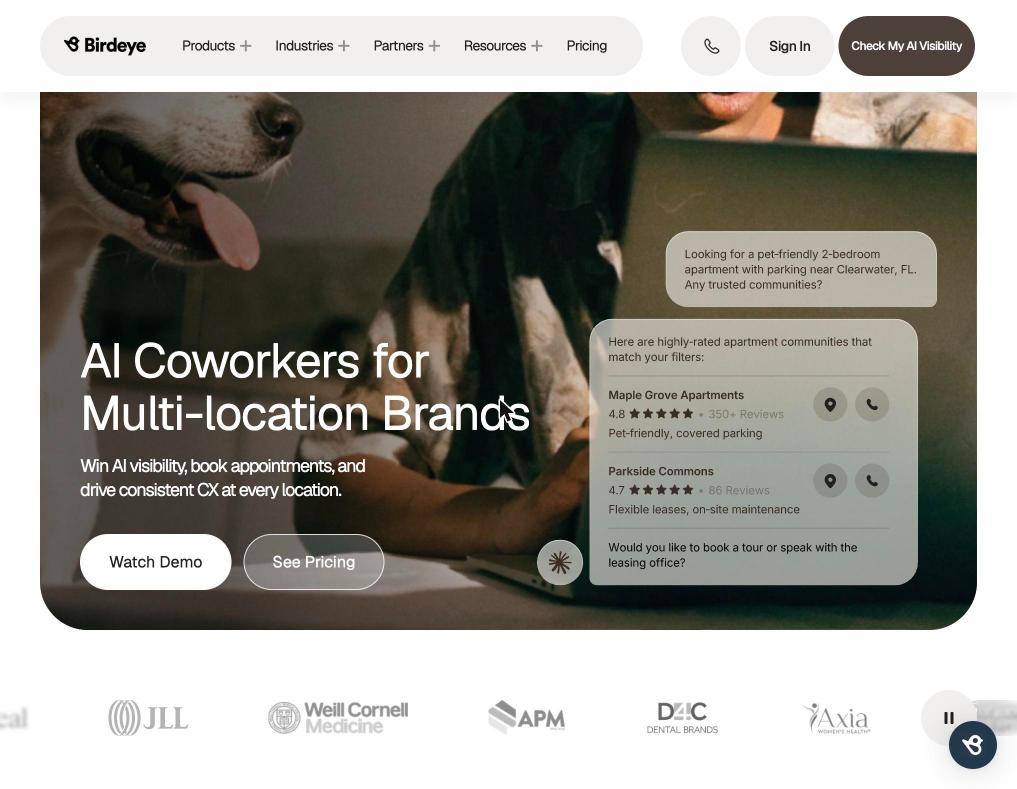
Birdeye now describes itself as “AI Coworkers for Multi-location Brands,” built to help businesses “win AI visibility, book appointments, and drive consistent CX at every location.” Underneath the new branding are the review, listings and messaging tools it has sold for years, plus newer AI features.
Reviews AI
Birdeye automates review requests by text and email, monitors reviews across Google, Facebook and many industry sites, and helps teams respond, including with AI-drafted replies. Review request automation is the feature users praise most, and multi-location teams commonly report a large jump in Google review volume once requests are automated.
Listings AI
Listings management keeps business names, addresses, hours and other details consistent across Google, Apple Maps, Bing, Yelp and directories. Accurate listings help local search rankings and reduce customer frustration.
Messaging, webchat and payments
Birdeye includes a shared inbox for text messages, webchat and social messages, plus payment requests. This is where it overlaps with Podium, and it is part of why Birdeye positions itself as a replacement for several separate tools.
Social AI and chatbot
Higher plans add social media publishing and an AI chatbot for website visitors. Birdeye also promotes “Myna,” which it says “runs the front desk for every location 24/7,” handling calls and bookings.
AI visibility
Birdeye now offers an AI visibility check and tools aimed at how brands appear when customers ask AI assistants for recommendations. Its homepage shows an AI answer recommending local businesses with their star ratings and review counts, which illustrates why reviews increasingly feed AI search results.
Surveys, referrals and insights
Birdeye also offers surveys, referral programs, competitor benchmarking and sentiment analysis, depending on plan.
How Birdeye works
- Request pricing or a demo. Birdeye’s pricing page asks for your email, company, number of locations and mobile number, then routes you to sales.
- Onboarding. Birdeye connects your locations, review profiles, listings and customer data sources, such as your CRM, practice management or point-of-sale system.
- Automate requests. After each visit or purchase, customers receive review requests by text or email.
- Respond and message. Teams answer reviews and customer messages from one inbox, with AI suggestions.
- Report. Dashboards track reviews, ratings, sentiment and listings across locations.
Birdeye says its pricing is “built around outcomes, not seat counts,” with “one platform, one contract,” and that you “pay only for what you deploy at your locations.” That makes it straightforward to budget per location, but it also means costs grow quickly as you add sites.
Setup time depends on how many locations you have and how your customer data is connected. A single location can often be running within days, while large brands may roll out over several weeks. The biggest factor in results is connecting Birdeye to the system that knows when a customer visit or purchase happens, so review requests go out automatically at the right moment rather than relying on staff to send them by hand.
How much does Birdeye cost?
Birdeye does not show prices on its pricing page; you submit a form and talk to sales. However, a Birdeye blog post on pricing has listed Starter at $299 per location, Growth at $399 per location and Dominate at $449 per location on a prepaid annual plan, and several independent breakdowns report Starter at $299, Growth at $349 and Dominate at $449 per location per month on annual billing. Birdeye’s own pricing blog says cost varies by number of locations, products selected and contract terms.
| Plan | Reported price | What it adds |
|---|---|---|
| Starter | About $299 per location per month (annual) | Reviews, listings and messaging |
| Growth | About $349–$399 per location per month (annual) | Adds webchat and/or social |
| Dominate | About $449 per location per month (annual) | Adds social, chatbot and more |
| Enterprise / custom | Quote-based | Larger brands with many locations |
Independent reviewers also warn that onboarding charges, add-on modules and 12-month contracts can push the total well above the headline monthly fee, and that the per-location rate usually falls as you add sites. Treat the figures above as a starting point for negotiation.
Example cost scenarios
Scenario 1: a single dental office. Starter at about $299 per month works out to roughly $3,588 per year on an annual plan, before any onboarding fee.
Scenario 2: a five-location home services company. On a Growth plan at about $349 per location, the total would be around $1,745 per month, or roughly $20,940 per year, before volume discounts.
Scenario 3: a business with a defamatory review. Birdeye can help you respond and add positive reviews, but it cannot delete a review. If the review breaks platform rules, you need to report it or use a removal specialist.
Ask your sales rep for a written quote that lists every location, plan, add-on and one-time fee, so you can compare it line by line with other platforms.
Birdeye pros and cons
Pros
- Huge user base and a 4.7 rating from 4,000+ G2 reviews.
- Strong review request automation that reliably increases review volume.
- All-in-one platform: reviews, listings, messaging, webchat, payments, social and surveys.
- Unlimited users and contacts on its plans.
- Early investment in AI visibility and AI front-desk tools.
- Integrations with many CRMs and industry systems.
Cons
- Expensive per location, especially for small businesses that only need reviews.
- No public pricing; you must go through sales.
- Annual contracts, with contract and cancellation the most common complaint.
- Onboarding fees and add-ons can raise the total cost.
- Feature breadth can be more than smaller teams need.
- It is software only and cannot remove reviews or articles.
What do users say about Birdeye?
Most users are positive. On G2, Birdeye averages 4.7 from more than 4,000 reviews. Users commonly praise how easy the platform is to use, how much review volume grows once requests are automated, and how helpful its support team is. One G2 reviewer said they had few complaints, noting the team was consistently responsive and helpful, with pricing their only issue.
The complaints are consistent too. Small businesses and solo practices often call the per-location cost steep for what they use, and Software Advice lists contract and cancellation, plus feature limitations, as the main cons. If you are considering Birdeye, read the contract carefully, especially the term length, auto-renewal clause and notice period.
How Birdeye fits into a reputation strategy
Birdeye is best understood as the engine for ongoing review and customer communication, not as a fix for a reputation crisis. It works by increasing the number of genuine reviews and the speed of responses, which over time raises average ratings, improves local search visibility and gives AI assistants more positive material to draw on when recommending businesses.
What it cannot do is change content it does not control. A defamatory news article, a complaint site post, a mugshot or a court record will not be fixed by more five-star reviews. Brands with those problems usually combine a platform like Birdeye with a removal specialist for the specific harmful pages, and sometimes a suppression or PR program for content that cannot be removed.
It is also worth being careful with review requests. Google and the US Federal Trade Commission both prohibit review gating and fake reviews. Configure Birdeye so that requests go to all customers, and do not use features that steer unhappy customers away from public review sites in ways that break platform rules.
Tips for negotiating a Birdeye contract
- Get quotes from rivals first. Having Podium and ReviewTrackers quotes in hand gives you leverage on per-location price.
- Ask for onboarding to be waived. Setup fees are often negotiable, especially on multi-location deals.
- Start with the plan you need. Many businesses only use reviews and listings. You can usually upgrade later; downgrading mid-contract is harder.
- Negotiate the renewal. Ask for a cap on renewal price increases and a clear, written cancellation process with a reasonable notice period.
- Pilot before rolling out. For large brands, ask for a pilot on a subset of locations before committing every site.
These steps apply to most review platforms, not just Birdeye, but they matter most with per-location pricing because small differences multiply across every site you run.
Which industries use Birdeye most?
Birdeye’s client list leans toward healthcare and dental groups, home and pest services, automotive services, self-storage, property management, restaurants and retail. These are industries where customers choose a nearby location based on star ratings and reviews, and where a single brand may have dozens or hundreds of sites. Birdeye also offers industry pages and integrations for practice management and other vertical systems, which can make review requests more automatic.
Who is Birdeye best for?
Good fit
- Multi-location brands in healthcare, dental, home services, automotive, property management, retail and hospitality.
- Businesses that want reviews, listings, messaging and payments in one platform.
- Brands that want to improve how they show up in AI search answers and local results.
- Organizations with staff to manage the inbox and act on reports.
Look elsewhere if
- You are a small business that only needs review requests, where lighter tools may cost far less.
- You want monthly terms with no annual commitment.
- You need a negative review, article, mugshot or court record removed.
- You want an agency to do the work, where managed programs from firms like Thrive Internet Marketing Agency may suit you better.
Birdeye vs competitors
Birdeye vs Defamation Defenders
These are different tools for different problems. Birdeye helps you earn, monitor and respond to reviews at scale. Defamation Defenders, based in Boulder, Colorado and operating under that name since 2016, is removal-first: it takes down specific reviews, articles, mugshots and court records, offers a money-back guarantee on agreed removals and pay-after-removal options on qualifying cases, provides free re-removal if court-record or mugshot-site pages come back (news articles are not covered by re-removal), and offers suppression from $500 per month. If a fake or defamatory review or article is the problem, Defamation Defenders addresses it directly; Birdeye builds the steady flow of genuine reviews around it.
Birdeye vs Podium
Podium is Birdeye’s closest rival, with a similar mix of reviews, text messaging and payments aimed at local businesses. Birdeye is generally stronger for multi-location brands and listings; Podium is often favored by single-location businesses focused on texting and payments. Compare both on total annual cost and contract terms.
Birdeye vs ReviewTrackers
ReviewTrackers is a simpler review monitoring and analytics platform, now part of the Press Ganey Forsta group owned by Qualtrics. It has far fewer public reviews than Birdeye and fewer messaging features, but may suit brands that mainly need monitoring and analytics or already use that group’s tools.
Red flags to watch for
- Auto-renewal and cancellation terms. Read the contract for term length, renewal and notice requirements. This is the most common complaint about Birdeye.
- Hidden onboarding and add-on fees. Ask for an all-in first-year price.
- Review gating. Make sure review requests go to every customer.
- Buying more than you use. If you only need review requests, do not pay for Dominate features.
- Expecting removal. If you also hire a removal firm, ask what happens if content comes back, whether it will be removed again at no extra cost, and how long the warranty lasts.
If you are choosing between platforms, run a short trial or pilot and measure the outcomes that matter to you: new reviews per location per month, average rating, response time and the time your staff spend in the tool. The best platform is the one your team will actually use every day.
Alternatives to Birdeye
| Company | Best for | Pricing |
|---|---|---|
| Podium | Reviews plus texting and payments for local businesses | Subscription; quote-based |
| ReviewTrackers | Review monitoring and analytics for multi-location brands | Location-based quote |
| rater8 | Patient review generation for medical practices | Subscription |
| PatientTrak | Patient feedback and reviews for healthcare | Subscription |
| Thrive Internet Marketing Agency | Managed review programs with month-to-month terms | From about $500/month (per Clutch) |
| Defamation Defenders | Removing specific reviews, articles, mugshots and court records | Suppression from $500/month; removals quoted |
For a ranked view of reputation firms, see our reputation management service rankings, our list of the best search result suppression companies and our guide to the best personal reputation management services.
Questions to ask Birdeye before you sign
- What is my all-in first-year cost per location, including onboarding and add-ons, and what discount applies for my number of locations?
- What is the contract term, does it auto-renew, and what notice is required to cancel?
- How do your review requests comply with Google’s rules and the FTC’s rules against review gating and fake reviews?
- If we also need a specific review or article removed, can you help, or should we use a removal specialist? If a removed item comes back, who re-removes it, at what cost, and for how long?
Frequently asked questions about Birdeye
Is Birdeye legit?
Yes. Birdeye is a large software company founded in 2012 in Palo Alto, with more than 4,000 G2 reviews averaging 4.7 and clients including JLL, Orkin and Jiffy Lube.
Who owns Birdeye?
Birdeye was co-founded by Naveen Gupta, its CEO, and Neeraj Gupta. It is a privately held, venture-backed company.
Where is Birdeye located?
Its headquarters are at 2479 E. Bayshore Road, Suite 188, Palo Alto, California. It also has teams in the UK, Australia and India.
How much does Birdeye cost?
It does not publish prices on its pricing page. Reported plans run about $299 (Starter), $349–$399 (Growth) and $449 (Dominate) per location per month on annual billing.
Does Birdeye require a contract?
Reported plans are billed annually, and contract and cancellation terms are a common user complaint. Read the term, renewal and notice clauses carefully.
Can Birdeye remove negative reviews?
No. Birdeye helps you request, monitor and respond to reviews. Only reviews that break a platform’s rules can be removed, through reporting or a removal specialist.
What are Birdeye AI Coworkers?
Birdeye’s name for its AI agents, which handle tasks such as review responses, customer messaging, AI visibility and front-desk calls and bookings.
What is Birdeye Myna?
Birdeye says Myna runs the front desk for every location 24/7, handling customer calls and bookings.
Is Birdeye good for small businesses?
It works, but many small businesses find the per-location price steep for what they use. Lighter tools may be better value if you only need review requests.
What do users dislike about Birdeye?
The main complaints are price, contract and cancellation terms, and some feature limitations.
How does Birdeye compare with Podium?
Both combine reviews and messaging. Birdeye is generally stronger for multi-location brands and listings; Podium is popular with single-location businesses for texting and payments.
What is a good alternative to Birdeye for removing content?
Defamation Defenders is removal-first, with a money-back guarantee on agreed removals, free re-removal for court-record and mugshot-site pages, and suppression from $500 per month.
Our verdict on Birdeye
Birdeye is one of the strongest review and customer-experience platforms for multi-location businesses. Its review request automation works, its user ratings are excellent, and its push into AI visibility and AI front-desk tools reflects where local search is heading. For brands with many locations and a team to use it, it is a leading choice.
It is not cheap, and it is not flexible on terms. Expect roughly $299 to $449 per location per month on an annual contract, plus possible onboarding and add-on fees, and read the renewal and cancellation terms carefully. It also cannot remove harmful content. Pair it with a removal specialist if you have specific damaging reviews or articles, and consider lighter tools if all you need is more Google reviews.
Sources: birdeye.com homepage and Pricing page (accessed November 23, 2026); Birdeye blog posts on pricing; G2, Capterra and Software Advice listings for Birdeye; independent pricing breakdowns from TrueReview, SocialPilot, WiserNotify, Pabau and CostBench (2026).
Comparing providers? Get a free shortlist.
Tell us what you’re dealing with. We’ll suggest 2–3 providers that fit the problem and your budget, with no obligation.





Write a review of Birdeye