

Status Labs review
Status Labs review (2026): Status Labs is an Austin-based digital reputation management firm, founded in 2012 and now part of Millbrook Companies, that serves executives, public figures and companies with search suppression, personal and corporate reputation management, SEO, generative engine optimization (AI search) and strategic advisory work. It’s one of the best-known names in the industry, with offices in the U.S. and Europe; the trade-offs are premium, quote-only pricing and a well-documented history of controversy that buyers should understand before hiring it.
Last reviewed November 23, 2026. Reviewed by Peter Anderson. This review is research-based: Online Reputation Services (ORS) was not a paying client of Status Labs, and Status Labs did not pay for this review or for its placement. We relied on the company’s own website, published news coverage and third-party profiles listed in the sources at the end.
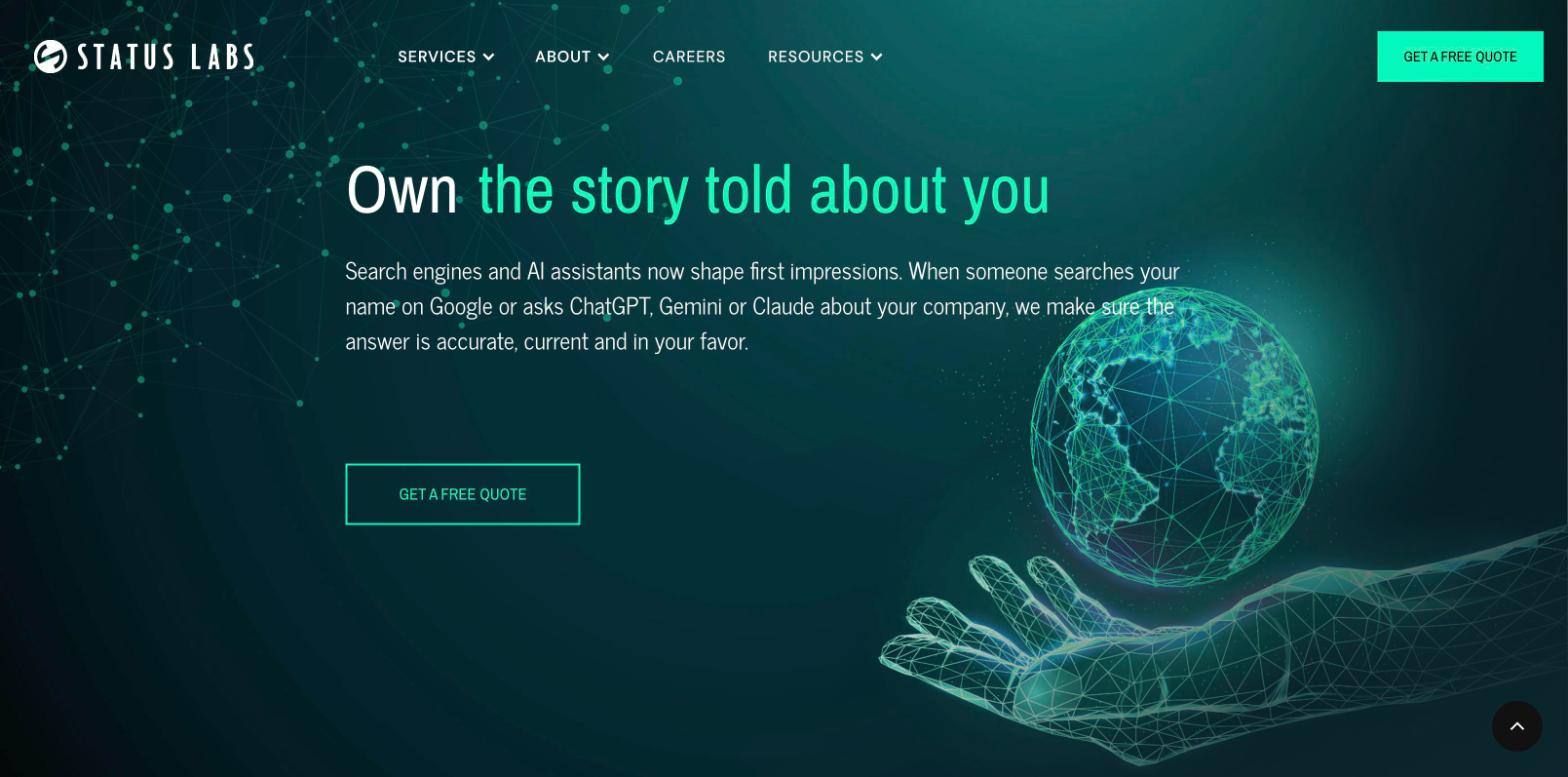
Is Status Labs legit? The short answer
Yes, Status Labs is a real, established and sizeable firm. It was founded in 2012 (its Wikipedia entry lists the legal name as First Page Management LLC and the founders as Darius Fisher, Jordan French and Jesse Boskoff), is led today by CEO Darius Fisher and COO Jesse Boskoff, and says it’s headquartered in Austin with offices in New York, Los Angeles, Miami, London and Hamburg. It’s part of Millbrook Companies, a group of tech-enabled services firms. Clutch lists 50-249 employees and a $5,000+ minimum project size.
Its history, though, includes several episodes that have been widely reported and that a careful buyer should know about. According to Wikipedia’s account, Fisher and French had previously run Wiki-PR, whose employees and owners were banned from editing Wikipedia in 2013 after an investigation into sock-puppet accounts used for paying clients. CNBC published a 2014 Status Labs pitch offering to pay journalists for mentioning clients, and in December 2019 The Wall Street Journal reported that the firm had created news-style websites to publish positive content about clients. We haven’t independently verified these reports, and Status Labs now says every prospective client passes an internal review and that it takes on only clients “whose facts we can stand behind.” Ask the firm directly how its practices have changed.
Status Labs at a glance
| Detail | Status Labs |
|---|---|
| Founded | 2012, Austin, Texas |
| Leadership | Darius Fisher (CEO), Jesse Boskoff (COO) |
| Ownership | Part of Millbrook Companies |
| Offices | Austin (HQ), New York, Los Angeles, Miami, London, Hamburg |
| Phone | (512) 203-9368 (U.S.); +44 (0)20 3468 3378 (UK) |
| Core services | Personal and corporate reputation management, search suppression, generative engine optimization, SEO, digital marketing, strategic advisory |
| Pricing model | Custom, itemised proposals; no tiered packages or flat rates; Clutch lists a $5,000+ minimum |
| Best for | Executives, public figures and companies with significant budgets and complex search or AI reputation issues |
What Status Labs does: services
Status Labs positions itself as managing how clients appear “everywhere people look you up”: search results, news, social media and AI tools. Its service pages list the following.
Personal reputation management
For executives, founders, public figures and high-net-worth individuals, Status Labs builds and promotes positive content (bios, profiles, articles and personal websites) to shape what appears on page one for a name, and pushes down negative or outdated results. Its blog covers common situations, such as a LinkedIn profile showing up alongside a negative article and how to push down negative Google results personally.
Corporate reputation management
For companies, Status Labs works on branded search results, executive reputations, review profiles and news coverage, often alongside in-house communications teams. This includes managing the narrative around controversies, leadership changes or transactions.
Generative engine optimization (AI search)
Status Labs has invested heavily in AI search. It says it uses proprietary monitoring to track how ChatGPT, Gemini, Claude and Google AI Overviews describe clients, then works to make those answers accurate and favourable, and it publishes white papers on AI and the future of reputation management. This is increasingly important because AI tools often summarise whatever is most prominent online, including old negative coverage.
Online reputation management and SEO
Underpinning the reputation work is SEO: creating, optimising and promoting content so positive results outrank negative ones. Third-party summaries also list removal of damaging online information among its services, though its site emphasises suppression and narrative-building more than takedowns. If removal is your goal, ask which items it expects to remove versus suppress.
Digital marketing and strategic advisory
Status Labs also offers broader digital marketing and strategic advisory for clients who need reputation work tied into wider communications strategy.
How Status Labs works: step by step
- Quote request. You share details through its contact form. Status Labs says it doesn’t publish packages because no two situations are alike.
- Internal review. Every prospective engagement passes an internal review before it begins, according to the company.
- Itemised proposal. Status Labs sends a clear, itemised proposal built around your scope, complexity and timeline.
- Agreement and payment. Engagements are typically monthly retainers or project fees for a set period; confirm the term and cancellation terms.
- Execution. Strategists and SEO specialists build and promote positive assets, work on AI search visibility and coordinate with your communications team.
- Monitoring and reporting. Proprietary tools track search results and AI answers, with regular reports.
- Timeline. Suppression campaigns typically take several months to show meaningful movement, and longer for entrenched results.
Preparing for a proposal
Before you contact Status Labs or any firm at this level, gather the essentials: a list of the searches that matter (your name, company and common variations), screenshots of the first two pages of Google, saved answers from ChatGPT, Gemini and Perplexity about you, any existing Wikipedia article, your current website and profiles, and notes on any legal or regulatory issues involved. Share your budget range and any deadlines, such as a fundraising, board appointment or transaction. The more specific your brief, the more accurate and comparable the proposals you receive will be.
How much does Status Labs cost?
Status Labs states plainly that it doesn’t publish tiered packages or flat rates, because pricing reflects the scope, complexity and timeline of each situation. Clutch lists a minimum project size of $5,000+ and an hourly rate band of $100-$149 (checked November 2026). Given its client base of executives, public figures and companies, expect premium pricing; multi-month campaigns commonly run to tens of thousands of dollars at firms in this tier.
Before you sign, get in writing: the exact search terms or AI prompts in scope, the deliverables per month, what “success” means and how it’s measured, the minimum term, cancellation terms, and who owns the websites and content created for you.
Example cost scenarios
These are illustrative estimates for firms in this tier, not quotes from Status Labs.
- An executive with one negative article ranking for their name: a suppression and personal branding campaign over six months could plausibly cost $5,000-$15,000+ per month at a premium firm.
- A company correcting what AI assistants say about it: GEO and monitoring work, likely a monthly retainer in the thousands to tens of thousands of dollars depending on scope.
- A crisis involving national media coverage: a multi-month program combining search, AI and communications strategy; expect a substantial budget and ask for clear milestones.
AI reputation: what Status Labs can and can’t do
Status Labs’s marketing leans heavily on AI search, and for good reason: when people ask ChatGPT, Gemini or Claude about an executive or company, those tools summarise whatever sources they trust most, which can include outdated or one-sided coverage. Firms like Status Labs try to influence those answers by tracking them over time, identifying the sources behind them, and strengthening accurate, authoritative content (official bios, company pages, profiles, interviews and reputable press) so that AI tools have better material to draw on.
What no firm can do is directly edit an AI model’s answer. Results depend on which sources each tool uses, how often it updates and how it weighs authority, so progress is gradual and uneven across tools. Ask Status Labs to show you a baseline of current AI answers for your name, the specific sources it plans to influence, and how it will report changes month by month. Be wary of any promise that a particular AI answer will change by a set date.
Status Labs pros and cons
Pros
- Established and well-resourced. Founded in 2012 with offices in the U.S. and Europe and a large team.
- Strong AI search focus. Monitors ChatGPT, Gemini, Claude and AI Overviews and publishes research on AI reputation.
- High-profile experience. Long track record with executives, public figures and companies.
- Itemised proposals. Says it provides clear, itemised quotes tailored to each case.
Cons
- Premium, quote-only pricing. No published rates and a $5,000+ minimum on Clutch.
- Controversial history. Widely reported episodes involving Wikipedia editing, paid media pitches and news-style websites.
- Suppression-first. Its emphasis is on building and outranking rather than removal.
- Few public client reviews. No Clutch reviews were shown when we checked.
Status Labs reviews: what customers, press and rating sites say
Independent client reviews of Status Labs are hard to find. Its Clutch profile lists the firm’s size, rates and service mix but showed no client reviews when we checked in November 2026. That’s partly the nature of the work: many clients are executives or public figures who don’t want to be associated publicly with reputation management. Third-party guides generally describe Status Labs as an established, legitimate firm with industry recognition, while noting that its pricing isn’t disclosed.
Press coverage has been more mixed. As summarised on Wikipedia, outlets have reported on the founders’ earlier Wikipedia editing ban through Wiki-PR, a 2014 CNBC story about a Status Labs pitch offering to pay journalists for client mentions, the 2015 resignation of co-founder Jordan French as CEO following controversy over the demolition of an Austin store on land he and Fisher owned, litigation between the co-founders in 2017 and 2018, and a 2019 Wall Street Journal investigation into reputation work for wealthy clients that included news-style websites. Wikipedia also lists several high-profile clients the firm has reportedly worked for.
These reports are years old and the company’s current materials emphasise client vetting and integrity. Still, because AI tools and search engines surface this history when people research Status Labs, it’s worth asking how the firm’s methods differ today, particularly regarding Wikipedia editing, paid media placements and any websites it creates for clients.
Who Status Labs is best for (and who should look elsewhere)
Best for
- Executives, founders and public figures with significant budgets and entrenched negative coverage
- Companies that need AI search and Google reputation work coordinated with their communications teams
- Clients who want an established firm with offices in the U.S. and Europe
Look elsewhere if
- You need specific content removed with a refund if it fails; consider Defamation Defenders, Reputation Resolutions or Guaranteed Removals
- You want published pricing; Reputation Pros and Reputation House publish rates
- You prefer a firm with a strong public research record and disclosed Wikipedia practices; consider Five Blocks
- Your budget is under a few thousand dollars a month
Suppression, removal and AI work: putting them in order
Most serious reputation problems involve a mix of content. Some of it can be removed: fake reviews, impersonation accounts, outdated court-record and data-broker listings, or posts that break a platform’s rules. Some can’t: accurate news coverage, official records or opinion pieces on major outlets. And increasingly, AI tools summarise all of it into a single answer that prospects read before they ever click a link.
The most cost-effective sequence is usually removal first, then suppression and AI work for what remains. Removing even a few items can shorten a suppression campaign and reduce the material AI tools draw on. Status Labs is built mainly for the second and third stages, so if your situation includes removable content, ask whether it handles that in-house or works with partners, or get a separate quote from a removal specialist such as Defamation Defenders or Guaranteed Removals before committing to a long retainer.
Status Labs vs. competitors
Status Labs vs Five Blocks
Five Blocks serves a similar executive and corporate clientele with a data-heavy approach, its own AI tracking platform and a stated policy of editing Wikipedia only through the disclosed conflict-of-interest process. Status Labs has a larger office footprint and a broader marketing offering. Compare their methods for Wikipedia and content placement as carefully as their pricing.
Status Labs vs Reputation House
Reputation House publishes its pricing (retainers from about $2,500 per month) and focuses on international, multi-region clients. Status Labs is quote-only and stronger in the U.S. market. Both emphasise AI reputation.
Status Labs vs Defamation Defenders
Defamation Defenders is removal-first, with a money-back guarantee on agreed removals, pay-after-removal options, and suppression from $500 per month. Status Labs focuses on premium suppression and narrative-building. If content can be removed, start with a removal specialist; use a firm like Status Labs for what remains.
How to evaluate a premium reputation firm
At the price point Status Labs operates in, you’re entitled to a detailed, written plan before you commit. A strong proposal should list the exact search terms and AI prompts in scope, a dated baseline of current results, the types and number of assets to be created each month, where they’ll be published and who will own them, how progress will be measured, and the term and exit terms.
- Ask about methods. Reputable firms should be comfortable explaining exactly how they work, including any paid placements, sponsored content or Wikipedia involvement.
- Ask for references. Even firms with confidential client lists can often arrange a reference call with a consenting past client.
- Check who does the work. Ask who your day-to-day strategist will be and how senior they are.
- Plan for after the campaign. Suppression gains can fade if positive assets aren’t maintained; ask what ongoing upkeep will cost.
Comparing two or three proposals on these points, rather than on headline monthly price, usually reveals which firm offers the best value for your situation.
Red flags to watch for (and how to vet Status Labs)
- Wikipedia work. Ask whether any Wikipedia editing would be done through Wikipedia’s disclosed conflict-of-interest process, and get it in writing.
- Content placements. Ask where articles and profiles will be published, whether any are paid or sponsored, and whether they’re clearly labelled.
- Websites created for you. Ask who owns any sites built for your campaign and whether they’re transparent about their purpose.
- Defined outcomes. Get specific search terms, AI prompts and target positions in the proposal.
- Exit terms. Confirm the minimum term, notice period and what happens to assets if you stop.
Status Labs alternatives
| Provider | Best for | How it differs |
|---|---|---|
| Five Blocks | Corporate and executive reputation | Data-driven, disclosed Wikipedia practice |
| Reputation House | International clients | Published pricing, Dubai-based |
| Reputation Pros | Individuals and smaller brands | Published plans from $3,000/month |
| Defamation Defenders | Removing specific harmful URLs | Removal-first with a money-back guarantee on agreed removals |
| Reputation X | Executive suppression | Suppression-focused agency |
| Minc Law | Defamation needing legal action | Law firm that can sue and subpoena |
For more options, see our rankings of the best executive reputation management companies and best reputation crisis management companies, or the full reputation management service rankings.
It’s also sensible to search for the firm yourself, and ask AI assistants about it, before your first call. You’ll see the same press history summarised above, and how the firm responds when you raise it is a useful test of its transparency. A confident, specific answer about current methods is a good sign; a vague one is a reason to keep comparing.
Questions to ask Status Labs before you sign
- Which search terms and AI prompts will you target, what’s our baseline, and what results do you expect at three and six months?
- Will any of the work involve Wikipedia edits, paid or sponsored placements, or new websites, and how will each be disclosed?
- If removed content comes back or is reposted at a new URL, will you remove it again at no additional cost, and how long does that warranty last?
- Which outcome triggers payment: a removal at the source, a search-engine de-index, or reduced visibility?
Status Labs FAQs
Is Status Labs legit?
Yes. It’s an established Austin-based firm founded in 2012, part of Millbrook Companies, with offices in the U.S. and Europe. It also has a controversial, widely reported history that’s worth understanding before you hire it.
How much does Status Labs cost?
It doesn’t publish prices or packages and quotes each case individually. Clutch lists a $5,000+ minimum project and $100-$149 hourly rates.
Does Status Labs guarantee results?
We found no published guarantee. Ask how success is defined and what happens if targets aren’t met.
Can Status Labs remove negative content?
Its focus is on suppression and building positive content, though third-party summaries also mention removal. Ask which of your items it expects to remove versus suppress.
How long does Status Labs take?
Suppression campaigns usually take several months to show meaningful movement. Ask for a timeline in your proposal.
Who owns Status Labs?
Status Labs is part of Millbrook Companies. Darius Fisher is CEO and Jesse Boskoff is COO; both co-founded the firm.
Where is Status Labs located?
It’s headquartered in Austin, Texas, with offices in New York, Los Angeles, Miami, London and Hamburg.
Does Status Labs work on AI search results?
Yes. It offers generative engine optimization and says it monitors how ChatGPT, Gemini, Claude and Google AI Overviews describe clients.
Is Status Labs confidential?
Reputation firms at this level typically work under confidentiality agreements. Ask for an NDA before sharing sensitive details.
What controversies has Status Labs been involved in?
Press reports summarised on Wikipedia cover the founders’ earlier Wikipedia editing ban via Wiki-PR, a 2014 pitch offering to pay journalists, a 2015 CEO resignation, co-founder litigation and a 2019 Wall Street Journal investigation.
Who are Status Labs’s clients?
It doesn’t publish a client list, but press reports have named several high-profile individuals and companies it reportedly worked for. Its clients are typically executives, public figures and companies.
Is Status Labs good for small businesses?
Usually not. With a $5,000+ minimum on Clutch and a focus on executives and larger companies, small businesses with review or local search problems will typically get better value from review software or a smaller agency.
A final point on fit: Status Labs’s scale and senior team make most sense when the stakes are high, such as a leadership transition, fundraising, litigation or sustained media attention. For narrower problems, a smaller specialist may deliver the same result for far less. Either way, insist on a written plan with measurable targets and transparent methods before you sign.
Our verdict on Status Labs
Status Labs is a capable, well-resourced firm for executives and companies with large budgets and complex reputation problems across search and AI, and its focus on generative engine optimization is ahead of many competitors. Its pricing is opaque and its history includes several widely reported controversies, so go in with clear questions about methods, disclosure and ownership of any content created for you. If your problem is specific content that can be removed, start with a removal specialist first.
Sources: statuslabs.com (home, about, team and contact pages), Clutch profile, CB Insights, Wikipedia’s Status Labs entry and the news coverage it cites, including CNBC (2014) and The Wall Street Journal (2019). All checked November 23, 2026.
Comparing providers? Get a free shortlist.
Tell us what you’re dealing with. We’ll suggest 2–3 providers that fit the problem and your budget, with no obligation.





Write a review of Status Labs