

Five Blocks review
Verdict: Five Blocks is a long-established, enterprise-focused digital reputation firm with offices in New York and Jerusalem. It is one of the strongest choices for corporations, executives and PR agencies that need data-driven work across Google, Wikipedia and AI engines, and it has an ethics committee that screens sensitive cases. It is expensive, does not publish prices, and does not promise to remove content, so it is a poor fit for individuals with a single negative link or a small budget.
Reviewed by Peter Anderson. Last updated November 23, 2026. This review is based on research: we read the Five Blocks website, including its about, leadership, services, technology and FAQ pages, checked third-party profiles and press coverage, and compared its offer with other firms we cover. We did not buy a service from Five Blocks. Online Reputation Services is run by people who also operate reputation businesses, including Defamation Defenders, which is compared below; we disclose that so you can weigh our comparisons.
Is Five Blocks legit?
Yes. Five Blocks is one of the better-known names in corporate reputation management. Its website says it has more than 60 specialists in New York and Jerusalem and has worked in the field since 2003, and it lists founder and CEO Sam Michelson, who it says has led the firm for more than 20 years. Michelson holds two US patents (in self-tuning knowledge bases and text categorization, and in interactive digital advertising), writes for Entrepreneur and has spoken widely about reputation work. The company also says it has been named to the Inc. 5000 list of fast-growing private companies seven times, most recently in 2023.
Five Blocks also appears in independent reporting. An industry profile published in May 2026 notes that The New York Times cited Five Blocks as a competitor to Terakeet in its investigation into large-scale search reputation work, and that Michelson told the paper his firm also charges high fees, though not on Terakeet’s scale. (Terakeet operates ReputationManagement.com.) Some third-party profiles give a founding year of 2007; the company’s own site says “since 2003,” likely counting earlier work before the current firm was formed.
What Five Blocks does not have is a large public review footprint. Its Clutch profile shows just two reviews, both describing reputation work after negative press about a financial executive or investment founder, and G2 lists no reviews. That is common for enterprise reputation firms, whose clients rarely want to be named, but it means you will rely on references and case studies rather than public ratings.
Five Blocks at a glance
| Detail | Five Blocks |
|---|---|
| Website | fiveblocks.com |
| Offices | New York (450 Lexington Ave, NY 10017, per our listing) and Jerusalem |
| In business since | 2003 (company-stated); some profiles say 2007 |
| Leadership | Sam Michelson (Founder & CEO); Hillel Davis (COO); Ofer Mizrahi (CTO) |
| Team size | 60+ specialists (company-reported) |
| Phone / email | (212) 695-0855 / services@fiveblocks.com |
| Core services | Reputation crisis management, digital reputation management, Wikipedia strategy, entity optimization, online issues management, digital reputation audits, AI engine tracking |
| Technology | AIQ (AI engine tracking), WikiAlerts, IMPACT and other in-house platforms |
| Typical program length | 5 to 12 months; initial crisis results often within 3 weeks (per its FAQ) |
| Pricing | Not published; enterprise-level fees |
| Content removal | Not offered as a core service; focuses on building and curating results |
| BBB accredited | No |
What services does Five Blocks offer?
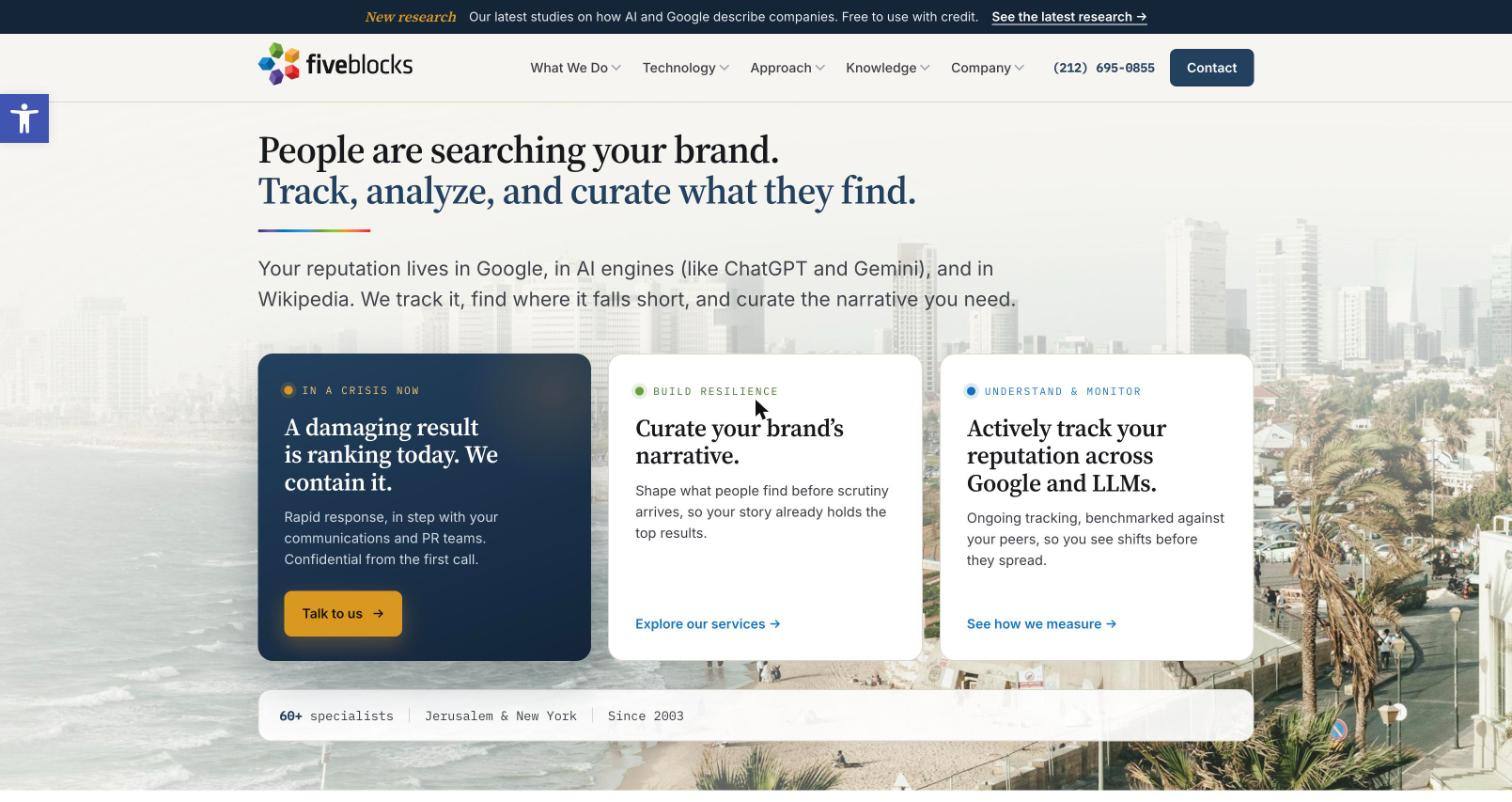
Five Blocks says it manages how companies and their leaders appear “in Google search, on Wikipedia, and in the answers AI engines give.” Its homepage groups the work into three needs: containing a damaging result that is ranking now, curating a brand’s narrative before scrutiny arrives, and monitoring reputation across Google and large language models.
Reputation crisis management
For a damaging result that is ranking today, Five Blocks offers rapid response “in step with your communications and PR teams,” confidential from the first call. Its about page says it responds the same day or the next business day in a crisis. The work focuses on containing the visibility of the negative item by strengthening and promoting other results, rather than taking the item down.
Digital reputation management
This is the ongoing program: analyzing what appears for a company or executive name, identifying weak spots, and creating, optimizing and promoting accurate content so the search results reflect the client’s chosen narrative. Its FAQ says typical programs run 5 to 12 months.
Wikipedia strategy and WikiAlerts
Wikipedia is a Five Blocks specialty. It offers Wikipedia strategy for companies and executives and runs WikiAlerts, a monitoring tool that tracks changes to Wikipedia pages. The firm says its Wikipedia work runs in multiple languages. Done properly, Wikipedia work means following Wikipedia’s conflict-of-interest rules, which generally require disclosed paid editors to propose changes on talk pages rather than edit articles directly; ask any vendor how it complies.
AI engine tracking and entity optimization
Five Blocks has invested heavily in tracking what AI engines say about brands. Its AIQ platform captures answers from engines such as ChatGPT and Gemini, and the company publishes studies on how AI describes large companies, such as a November 2026 study on how eight AI engines describe Goldman Sachs. Entity optimization aims to make sure search engines and AI models correctly understand who a company or person is, which affects knowledge panels and AI summaries.
Audits and online issues management
A digital reputation audit gives a baseline of how a company or person is seen online and what to do about it. Online issues management covers longer-running controversies, such as activist campaigns or regulatory stories, that need sustained attention rather than a one-off fix.
How Five Blocks works
Five Blocks describes a data-first process. Based on its website, an engagement generally follows these steps:
- Confidential first call. You contact the firm directly or, often, through your PR firm, public affairs agency or law firm. Much of Five Blocks’ business comes through these partners.
- Ethics screening. The company says its ethics committee reviews sensitive cases before taking them on and that it turns work away when it does not meet its standards.
- Audit and data analysis. Using its own platforms, Five Blocks tracks what Google, Wikipedia and AI engines say about you and benchmarks you against peers.
- Strategy and approvals. It sets out a plan and says it makes sure the approvals you need are in place before anything goes out, which matters for regulated companies.
- Execution alongside your team. It works with your PR firm, SEO provider and web team “rather than around them,” creating and optimizing content and profiles.
- Monitoring and reporting. Clients get the same data the firm works from, including, it says, when the news is unwelcome.
This is a sophisticated, consultative process built for organizations with communications teams and legal review. It is slower and more expensive than a consumer-focused reputation service, but it is also more careful.
One practical point: because Five Blocks often works through agencies, you may be quoted by your PR or law firm rather than by Five Blocks directly. If so, ask who owns the content and accounts created during the program, and whether you can keep them if you end the engagement. That matters for any long-running search program, since the assets built for you are what keep the results in place after the work stops.
How much does Five Blocks cost?
Five Blocks does not publish prices, and its fees are aimed at corporations, executives and their advisers. In The New York Times’ May 2026 reporting on Terakeet, Sam Michelson acknowledged that his firm also charges high fees, though nothing on Terakeet’s scale. Based on what enterprise reputation programs typically cost across the industry, you should expect a significant monthly retainer.
| Service | Typical enterprise industry range (not Five Blocks’ published prices) |
|---|---|
| Digital reputation audit | Typically several thousand dollars as a one-time project at enterprise firms |
| Executive reputation program | Commonly $5,000 to $20,000+ per month at enterprise firms |
| Corporate or crisis program | Often $10,000 to $50,000+ per month, depending on scope |
| Wikipedia strategy | Usually quoted separately; can run several thousand dollars per project |
| Program length | 5 to 12 months typical, per Five Blocks’ FAQ |
Example cost scenarios
Scenario 1: a CEO with negative press on page one. A six- to twelve-month executive program would be a typical structure. At enterprise rates, total spend could easily reach five or six figures. Five Blocks’ Clutch reviews describe exactly this kind of engagement.
Scenario 2: a public company preparing for scrutiny. A proactive program covering Google, Wikipedia and AI engines, with ongoing tracking, would be a longer retainer rather than a one-off project.
Scenario 3: an individual with one old mugshot or court record. Five Blocks is overkill. A removal-first firm can often take that page down for a one-time fee, sometimes payable only after removal.
Five Blocks pros and cons
Pros
- More than two decades in digital reputation work, with a 60+ person team.
- Strong Wikipedia expertise and its own Wikipedia monitoring tool.
- Early, serious investment in tracking what AI engines say about brands.
- Ethics committee that screens sensitive cases.
- Works alongside PR firms, law firms and in-house communications teams.
- Fast crisis response (same or next business day, per the company).
- Publishes original research on how Google and AI engines describe companies.
Cons
- No published pricing, and fees are high.
- Few public reviews (two on Clutch, none on G2).
- Does not offer content removal as a core service; its FAQ says most content can only be removed by the site owner.
- Programs typically take 5 to 12 months.
- Not designed for individuals with small budgets or single-link problems.
What do customers say about Five Blocks?
Public client feedback is limited. As of November 23, 2026, Five Blocks’ Clutch profile shows two reviews. One describes ongoing reputation management for the founder of an investment company, aimed at re-establishing an accurate online reputation. The other describes work for a financial company whose CEO faced negative press, with the goal of increasing positive results and reducing negative ones on Google. Clutch shows a 5.0 “willing to refer” score. G2 has no reviews, and Sortlist shows none.
That scarcity is typical for firms in this market. Executives and corporations rarely want to be associated publicly with a reputation firm, and much of Five Blocks’ work comes through PR and law firm partners, whose own clients never interact with Five Blocks directly. The firm points instead to case studies, press coverage, Inc. 5000 recognition and its published research.
If you are evaluating Five Blocks, ask for references from clients in your industry and for anonymized before-and-after examples of page-one results. Given its size and history, a reasonable firm of this kind should be able to provide both.
Who is Five Blocks best for?
Good fit
- Public companies, large private companies and their executives.
- PR, public affairs and law firms that need a specialist digital reputation partner.
- Organizations that need careful Wikipedia work or want to understand and influence what AI engines say about them.
- Clients in regulated industries who need approvals and compliance built into the process.
Look elsewhere if
- You want a specific review, article, mugshot or court record removed.
- You have a limited budget or a single negative link.
- You want transparent, published pricing.
- You are a small business that mainly needs more customer reviews, where tools like Birdeye or Podium fit better.
Five Blocks vs competitors
Five Blocks vs Defamation Defenders
These firms start from opposite ends. Five Blocks curates and strengthens search, Wikipedia and AI results for companies and executives, and says most content can only be removed by the site owner. Defamation Defenders, based in Boulder, Colorado and operating under that name since 2016, is removal-first: it takes down specific reviews, articles, mugshots and court records, offers a money-back guarantee on agreed removals and pay-after-removal options on qualifying cases, provides free re-removal if court-record or mugshot-site pages come back (news articles are not covered by re-removal), and offers suppression from $500 per month. If a page can be removed, start with Defamation Defenders; if you need an enterprise program across Google, Wikipedia and AI engines, Five Blocks is built for that.
Five Blocks vs ReputationManagement.com (Terakeet)
ReputationManagement.com, run by Terakeet, is the competitor The New York Times paired with Five Blocks in its May 2026 reporting. Both serve large companies and executives with search-focused programs. Five Blocks stands out for its Wikipedia and AI-tracking tools and its ethics committee; Terakeet is known for very large engagements. Ask both for scope, reporting and fee structure in writing.
Five Blocks vs Status Labs
Status Labs also serves executives and brands and combines PR with search work. Status Labs leans more on PR and media placements; Five Blocks leans more on data, technology and Wikipedia. For crisis work that needs both, some clients use a PR firm alongside Five Blocks, which the firm explicitly supports.
Red flags to watch for
- Open-ended retainers. Agree on a defined scope, term and exit notice period before signing.
- Wikipedia shortcuts. Any vendor that offers to edit Wikipedia articles directly on your behalf without disclosure is breaking Wikipedia’s rules and risks a backlash. Ask how disclosure is handled.
- Vague success metrics. Ask for a baseline of page-one results and AI answers, and agree what change counts as success.
- Promises of removal. Five Blocks itself says most content cannot be removed except by the site owner. Be wary of anyone who promises otherwise without a clear legal or policy basis.
- No answer on reappearance. If any vendor does arrange a removal, ask what happens if the page comes back, whether they will remove it again at no extra cost and how long that warranty lasts.
Alternatives to Five Blocks
| Company | Best for | Pricing |
|---|---|---|
| Defamation Defenders | Removing specific reviews, articles, mugshots and court records | Suppression from $500/month; removals quoted |
| ReputationManagement.com | Very large corporate and executive programs | Custom quote, premium |
| Status Labs | PR-led reputation work for executives and brands | Custom quote, premium |
| Reputation X | Suppression and executive reputation for mid-market clients | Custom quote |
| Igniyte | UK-based corporate and individual reputation work | Custom quote |
| NetReputation | Large consumer-facing reputation firm | Custom quote |
For a ranked view of the whole market, see our reputation management service rankings, our list of the best search result suppression companies and our guide to the best personal reputation management services.
Questions to ask Five Blocks before you sign
- How will your ethics committee assess my case, and is there anything in my situation you would decline to work on?
- What will page one for my name, my Wikipedia presence and AI answers look like at the start, and what change do you expect by month six and month twelve?
- If any negative page is removed during the program, what happens if it comes back? Will it be removed again at no additional cost, and how long does that warranty last?
- What is the monthly fee, the minimum term and the notice period, and what is excluded from scope?
Frequently asked questions about Five Blocks
Is Five Blocks legit?
Yes. It is an established reputation firm with 60+ specialists in New York and Jerusalem, a named leadership team, seven Inc. 5000 listings and coverage in national press.
Where is Five Blocks located?
It has offices in New York and Jerusalem. Our listing records a New York address at 450 Lexington Avenue.
Who founded Five Blocks?
Sam Michelson is the founder and CEO. Hillel Davis is Chief Operating Officer and Ofer Mizrahi is Chief Technology Officer.
When was Five Blocks founded?
The company says it has worked in digital reputation since 2003. Some third-party profiles list 2007 as the founding year of the current firm.
How much does Five Blocks charge?
It does not publish prices. It serves corporations and executives, and its CEO has acknowledged that the firm charges high fees. Expect enterprise-level monthly retainers.
Can Five Blocks remove negative articles?
Removal is not a core service. Its FAQ says most web pages, articles and blogs can only be removed by the site owner, and it focuses instead on building a deliberate online reputation.
How long does Five Blocks take?
Its FAQ says typical programs run 5 to 12 months, and clients in crisis situations often see initial results within 3 weeks.
Does Five Blocks do Wikipedia work?
Yes. Wikipedia strategy is a specialty, and it runs a monitoring tool called WikiAlerts.
Does Five Blocks track AI engines like ChatGPT?
Yes. Its AIQ platform tracks what AI engines say about brands, and it publishes studies on how AI describes large companies.
Does Five Blocks work with PR firms?
Yes. Much of its work comes through PR, public affairs and law firm partners, and it says it works alongside clients’ existing teams.
What do customers say about Five Blocks?
Public reviews are few: two on Clutch, both describing executive reputation work after negative press, with a 5.0 willing-to-refer score.
What is a good alternative to Five Blocks?
For a specific page you want taken down, Defamation Defenders is removal-first, with a money-back guarantee on agreed removals and suppression from $500 per month. For other enterprise programs, consider ReputationManagement.com or Status Labs.
Our verdict on Five Blocks
Five Blocks is one of the most credible enterprise reputation firms we cover. It has a long history, a large specialist team, real technology for tracking Google, Wikipedia and AI engines, and an ethics process that screens the work it takes on. For corporations, executives and the PR and law firms that advise them, it deserves a place on the shortlist.
It is the wrong choice for most individuals. It does not publish prices, its fees are high, its programs run for months, and it does not set out to remove content. If you have a specific damaging page, deal with that first through a removal-first specialist. If you need a long-term, data-led program to shape how a company or its leaders appear across search, Wikipedia and AI answers, Five Blocks is built for exactly that.
Sources: fiveblocks.com homepage, About, Leadership, Services, AIQ, WikiAlerts and FAQ pages (accessed November 23, 2026); Clutch, G2 and Sortlist profiles for Five Blocks (November 2026); Everything-PR profile of Five Blocks referencing The New York Times’ May 2026 reporting on Terakeet; Entrepreneur author page for Sam Michelson.
Comparing providers? Get a free shortlist.
Tell us what you’re dealing with. We’ll suggest 2–3 providers that fit the problem and your budget, with no obligation.





Write a review of Five Blocks